
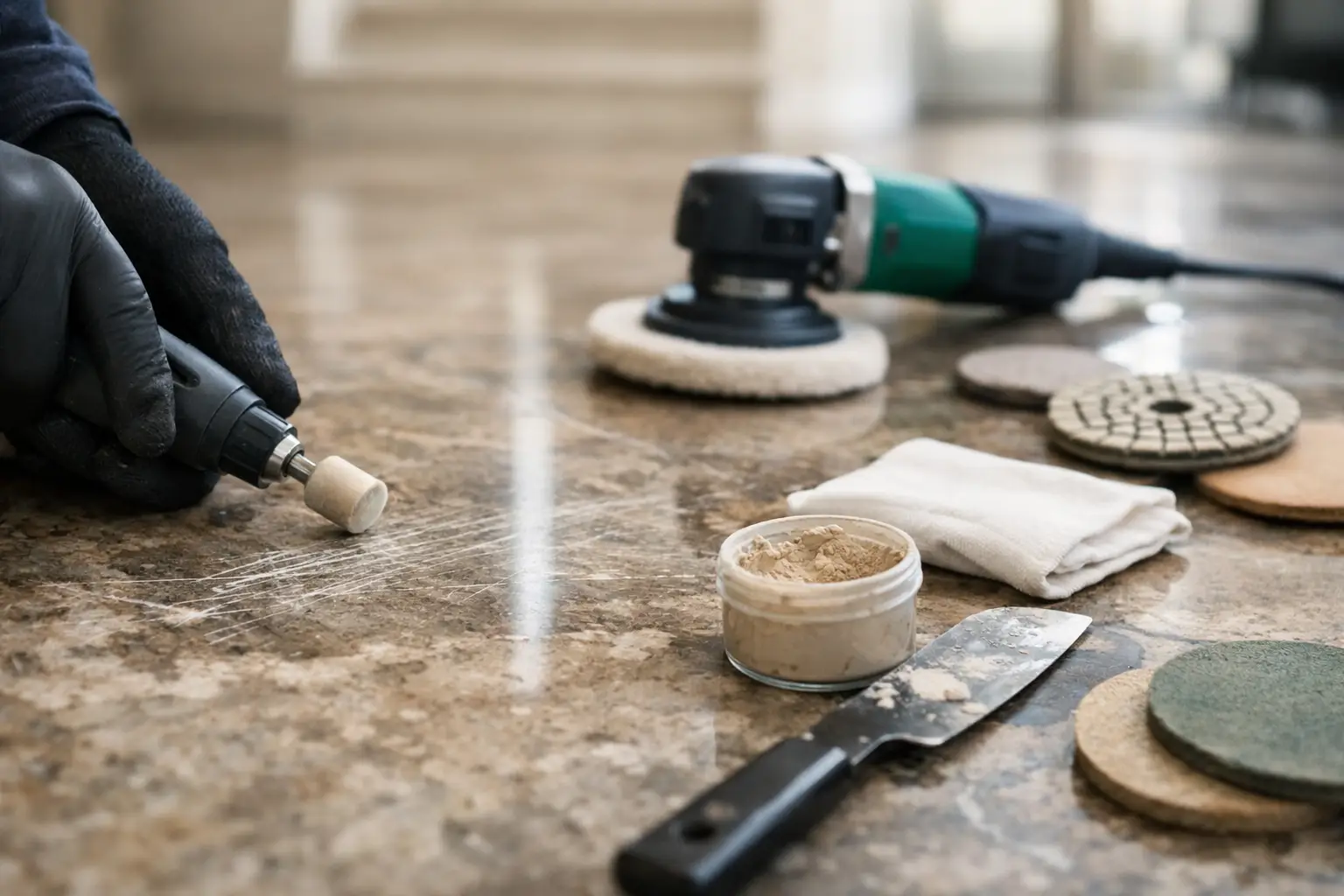
A scratched stone floor changes the whole room. Light catches every mark, polished surfaces look tired, and what should feel refined starts to look worn before its time. Stone floor scratch repair is not just about removing visible damage. It is about restoring clarity, reflection, texture and the sense of quality that natural and engineered stone bring to a space.
The right repair approach depends on the stone, the depth of the scratch, the existing finish and what caused the damage in the first place. A light surface mark on honed marble is a very different issue from deep scratching across polished granite in a commercial entry. Treat them the same way and the result is usually patchy, uneven or short-lived.
What causes stone floor scratches
Most stone floors are tougher than they look, but they are not immune to wear. Fine grit tracked in from outside is one of the biggest culprits. Under foot traffic, that grit behaves like sandpaper and gradually cuts into the finish. Furniture movement, metal chair legs, neglected entry mats and hard debris can all leave visible scratching.
In residential settings, the damage often builds slowly. Hallways, kitchens and living zones tend to show the first signs. In commercial interiors, repeated foot traffic can create dull lanes and scratch patterns that make even premium stone appear neglected.
Not every mark is a true scratch. Some floors show etching from acidic spills, and on polished marble or limestone this can resemble scratching at a glance. Other times, the sealer or topical coating is damaged rather than the stone itself. Correct diagnosis matters because the repair method must address the actual problem, not just the appearance of it.
Why stone floor scratch repair needs a stone-specific approach
Stone is not one material. Marble, limestone, travertine, terrazzo, granite and engineered stone all respond differently to abrasion, moisture, heat and polishing compounds. The density, mineral composition and finish level affect how scratches appear and how they should be treated.
Marble and limestone are generally softer and more vulnerable to scratching and etching. Granite is harder, but when it does scratch, blending the repair into a polished finish can require a more advanced process. Honed surfaces can often be restored with a lower sheen finish that disguises future wear more gracefully, while high-polish floors demand greater precision to avoid visible repair patches.
This is where many DIY attempts go wrong. A generic polishing product or abrasive pad may reduce one scratch while leaving swirl marks, changing the gloss level or creating a cloudy spot that stands out more than the original damage. Premium stone benefits from controlled restoration, not guesswork.
When a scratch can be spot repaired
Some minor surface marks can be treated locally, especially when the floor has a honed or matte finish and the damage is shallow. In these cases, the repair may involve fine abrasion, re-honing the affected area and blending the texture back into the surrounding stone.
Spot treatment works best when the scratch is isolated, the floor is in otherwise good condition and the finish is forgiving enough to allow a local blend. Even then, success depends on matching the surface precisely. On polished stone, isolated repairs are harder to conceal because light reflects differently off even small variations in gloss.
A good repair should not look like a repair. If a local treatment leaves a visible halo, flat patch or mismatched shine, it has not solved the problem.
When full restoration is the better option
If the scratching is widespread, if traffic paths are visibly dull, or if the floor has a mix of scratches, etching and general wear, broader restoration is usually the smarter investment. This means treating the floor as a whole rather than chasing individual marks.
In many cases, stone floor scratch repair is most effective when combined with honing and polishing across the full affected area. This creates a consistent finish, removes accumulated wear and brings the floor back to a balanced level of clarity and sheen. It also tends to be more cost-effective than repeated patch repairs that never quite match.
For high-end interiors, consistency matters. A beautifully restored floor should look intentional and complete, not improved in sections.
The usual repair process
Professional repair begins with inspection. The stone type is identified, the depth and spread of the scratching are assessed, and the existing finish is evaluated. That determines whether the job calls for localised correction, full resurfacing, polishing, sealing or protective treatment after the repair.
The repair itself usually involves diamond honing or polishing systems designed for stone, not general floor products. These abrasives gradually refine the surface to remove or reduce the scratch while preserving the integrity of the material. On polished stone, the surface is then brought back up to the required sheen. On honed floors, the aim is an even, elegant matte finish without obvious disruption.
Once the surface is restored, sealing may be recommended depending on the stone. Sealing does not make stone scratch-proof, but it can help protect against staining and support easier maintenance. In some environments, additional protective solutions may also make sense where long-term preservation is the priority.
What affects the final result
The first factor is scratch depth. Light wear within the surface finish is usually very manageable. Deep gouges that cut further into the stone may improve substantially but not always disappear without more intensive resurfacing.
The second factor is stone type. Softer stones often restore well because controlled abrasion can refine them effectively, but they are also more prone to future marking if maintenance is poor. Harder stones can deliver superb finished results, though the repair process may be more technically demanding.
The third factor is finish selection. A mirror polish is striking, but it will show more future wear than a honed finish in some settings. For busy family homes, apartment common areas or commercial foyers, choosing the right finish can improve both appearance and practicality.
Preventing scratches after repair
A beautifully restored floor deserves a maintenance plan that protects the investment. The simplest changes often make the biggest difference. Grit control at entrances matters. So does using proper felt protection under furniture and avoiding harsh cleaning tools that abrade the surface.
Cleaning products should also be chosen carefully. Stone-safe cleaners help preserve both the finish and any protective treatment applied after restoration. Acidic or highly aggressive products can dull certain stones and create a fresh round of problems that have nothing to do with scratching alone.
In presentation-critical spaces, regular professional maintenance can extend the life of the finish and reduce the need for heavier restoration later. That is especially relevant for commercial properties where stone floors contribute directly to first impressions.
Repair versus replacement
Many property owners assume visible scratching means the floor is nearing the end of its life. In reality, quality stone often has far more life left in it than its appearance suggests. Restoration can remove years of wear without the disruption, cost and inconsistency that often come with replacing stone.
Replacement also raises matching issues. New stone may differ in tone, veining or finish from adjacent areas, particularly in older properties. Repair and restoration preserve the original material while lifting the overall standard of the space. For premium interiors, that is often the better outcome both visually and financially.
Choosing the right specialist for stone floor scratch repair
This is a finish-driven trade. The difference between a general cleaner and a stone restoration specialist shows in the final surface. Proper stone floor scratch repair requires material knowledge, the right machinery, refined technique and an understanding of how to blend repairs so the floor looks complete again.
If the floor is marble, limestone, terrazzo, granite or engineered stone, the treatment should be tailored accordingly. Ask how the finish will be matched, whether the repair will be localised or full-area, and what protection is recommended afterwards. Experience matters most when the goal is not just damage removal, but a polished result that feels worthy of the property.
For homeowners and property managers in Sydney, that level of care is what separates a quick fix from true restoration. Grand Stone Restoration approaches scratched stone floors with the precision they require, restoring damaged surfaces to a standard that suits luxury homes, apartments and commercial interiors alike.
A scratched floor does not always need to be replaced, but it does need to be treated properly. When the repair respects the stone, the finish and the setting, the result is not simply less damage – it is a surface that looks composed, elegant and ready to perform again.