
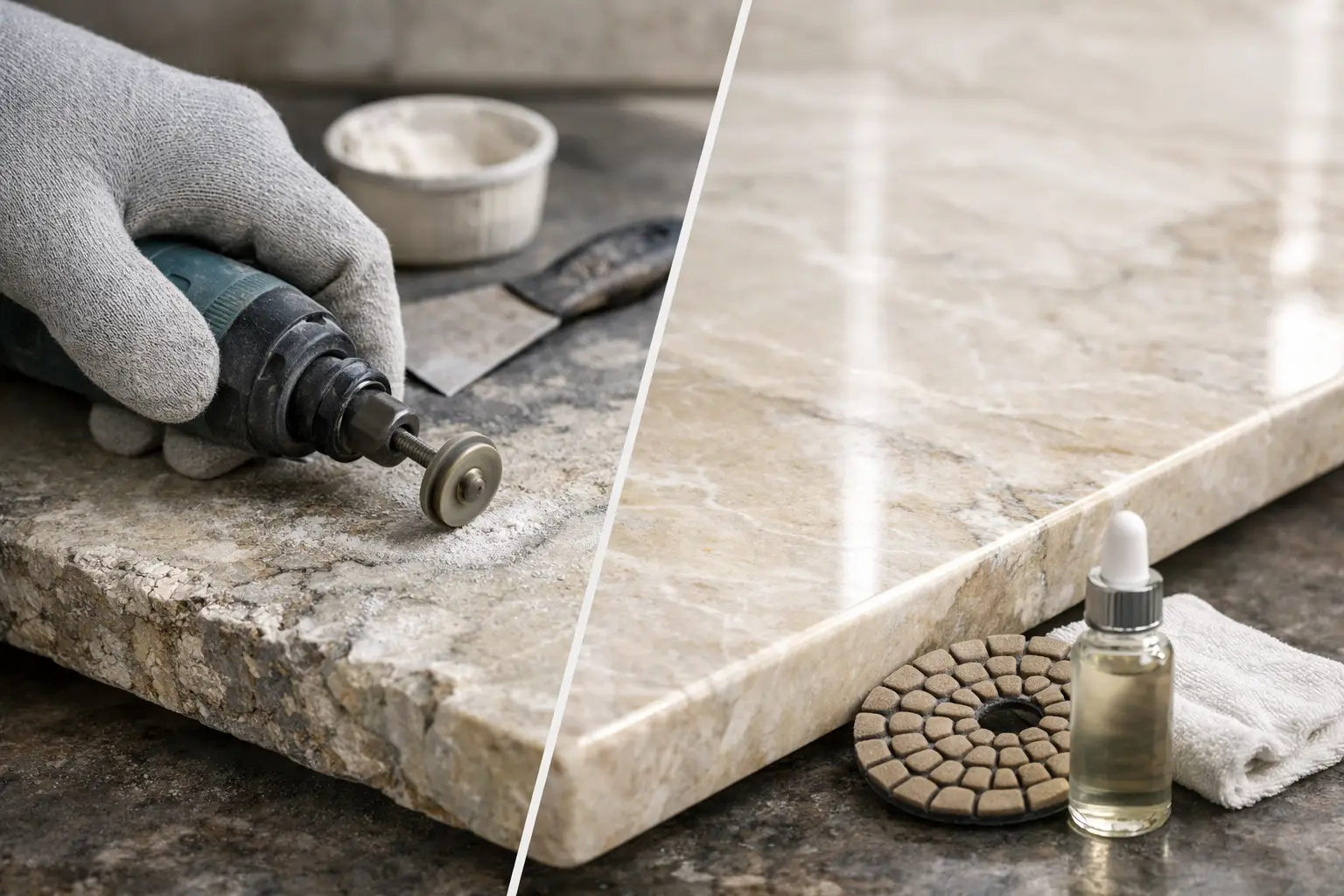
A marble vanity top with etch marks, a scratched foyer floor, a dull kitchen benchtop – these surfaces often look finished long before they actually are. In many cases, stone restoration instead of replacement is the smarter decision, preserving the material you already have while removing the damage that makes it look tired, dated or neglected.
Why choose stone restoration instead of replacement?
Replacement sounds straightforward until the real scope becomes clear. Removing stone usually means demolition, waste disposal, potential damage to adjacent cabinetry or wall finishes, installation delays, and the challenge of matching the original design intent. In premium homes and presentation-critical commercial spaces, that disruption is rarely minor.
Restoration offers a more considered path. When the underlying stone is still structurally sound, professional treatment can correct surface wear, revive clarity, refine the finish and restore a far more elegant appearance without tearing the space apart. The result is not a cover-up. Done properly, it is a material-specific process that brings the surface back to a standard much closer to its original character.
Cost is another major factor. Natural stone and engineered surfaces are substantial investments, and full replacement often carries a price well beyond the slab itself. Labour, site preparation, removal, fitting, edge work and downtime all add up. Restoration is typically far more economical, especially when the issue is etching, scratching, dullness, staining, minor chips or uneven wear rather than complete structural failure.
What restoration can actually fix
Many owners assume visible damage means the stone has reached the end of its life. That is often not the case. Most day-to-day deterioration affects the finish, not the entire slab or tile.
Marble commonly suffers from etching caused by acidic products, along with traffic wear that leaves floors flat and lifeless. Granite can lose polish in high-use zones or develop staining when sealing has been neglected. Limestone and travertine may show surface erosion, open pores and ingrained soiling. Engineered stone can become dull, marked or uneven in sheen. Tile and grout surfaces often present as old when the real issue is embedded grime, haze, discolouration or worn joints.
A skilled restoration process can address these issues through cleaning, honing, polishing, repair, sealing and protective treatments. Chips may be filled, scratches may be cut back, and surfaces can be refined to a consistent finish. The exact method depends on the stone type, the condition, and the result required. That last point matters, because good restoration is never one-size-fits-all.
The value of material-specific expertise
Stone is not a generic surface category. Marble responds differently to treatment than granite. Limestone requires a different level of care than terrazzo. Caesarstone and Silestone do not behave like natural stone, and the wrong technique can create more problems than it solves.
This is where specialist restoration stands apart from general cleaning or maintenance services. Proper assessment comes first. The stone needs to be identified correctly, the cause of the damage needs to be understood, and the treatment needs to suit both the material and the setting.
For example, a polished marble floor in a luxury residence may need a different level of refinement than a commercial lobby that prioritises durability and slip considerations. An outdoor sandstone area exposed to weather and organic staining will need a different approach again. The best outcome comes from matching the process to the stone, not forcing the stone into a standard process.
Where replacement may still be necessary
Restoration is often the better choice, but not always. If stone is cracked through its full depth, poorly installed, severely unstable, or compromised by major structural movement, replacement can become the practical option. The same applies where there is extensive breakage or where previous failed repairs have left too little material to work with.
That said, people often jump to replacement too early. A benchtop with edge chips, a floor with widespread etching, or a bathroom vanity with water marks may still be highly restorable. Surface damage can look dramatic, especially under downlights or in glossy interiors, yet remain well within the scope of expert treatment.
A proper inspection is what separates an unnecessary expense from a well-judged restoration plan. The right specialist will tell you when restoration is suitable and when it is not.
Stone restoration instead of replacement in residential spaces
In homes, the appeal is clear. Restoration preserves the look you chose in the first place while avoiding the upheaval that comes with replacement work. That matters in kitchens, bathrooms, living areas and entryways where stone is tied closely to cabinetry, joinery, fixtures and overall design continuity.
A restored marble floor can completely lift the feel of a home. Benchtops regain clarity and depth. Vanities look refined again rather than worn at the edges. Even grout restoration can sharpen the whole room, making tiled surfaces appear cleaner, brighter and more expensive.
There is also a timing advantage. Many homeowners want visible improvement without a drawn-out renovation. Restoration is often completed far more efficiently than replacement, with less mess and less interruption to daily life. For occupied homes, that practical benefit is hard to ignore.
The commercial case for restoration
For commercial properties, replacement is not only expensive but disruptive in ways that affect business operations. Stone in office foyers, retail spaces, hotels and apartment common areas contributes directly to first impressions. When it becomes dull, scratched or stained, the whole environment can appear less cared for.
Restoration provides a way to improve presentation without closing off major sections of the property for extended periods. It can also support asset maintenance strategies by extending the life of expensive finishes already in place. For building managers and facilities teams, that balance of appearance, cost control and reduced disruption is often what makes restoration the preferred path.
In Sydney properties where appearance standards are high and downtime matters, a polished, well-maintained stone surface is not simply aesthetic. It reflects on the property itself, the business operating within it, and the standard of care behind the space.
Protection matters as much as the repair
A beautifully restored surface is only part of the equation. Without proper protection, the same problems tend to return. Sealing helps reduce staining risk on suitable stones. Protective coatings may improve ongoing resilience in selected applications. Anti-etch film can be particularly valuable on vulnerable surfaces where acidic exposure is a recurring problem.
This is where restoration becomes a lifecycle service rather than a one-off cosmetic fix. Cleaning, correction and protection work best together. If a marble benchtop is polished but left exposed to the same etching cycle, the improvement may be short-lived. If a porous stone floor is cleaned but not sealed, staining can quickly return.
Lasting results depend on treating both the damage and the cause.
What a premium finish should look like
Not every shiny surface is a well-restored one. Quality restoration is measured by consistency, refinement and suitability to the material. The finish should feel deliberate, not overworked. Honed stone should look smooth and even, not patchy. Polished stone should have clarity and depth, not swirl marks or artificial-looking gloss.
The best work also respects the stone’s natural character. Marble should retain elegance, not look coated in plastic shine. Limestone should feel refined but appropriate to its softer aesthetic. Engineered stone should present evenly and cleanly without unnecessary alteration.
That level of finish comes from experience, technical control and attention to detail. Grand Stone Restoration approaches each surface with that standard in mind, because premium stone deserves specialist care, not guesswork.
When restoration is the smarter investment
If the stone is fundamentally sound, restoration is often the better financial and practical decision. You keep the original material, avoid demolition, reduce downtime and achieve a far stronger visual result than most people expect. More importantly, you protect the value of a surface that was worth choosing in the first place.
Replacement has its place, but it should not be the default response to wear, etching, staining or surface damage. In many cases, the stone does not need to be removed. It needs to be understood, treated correctly and brought back to life with craftsmanship.
Before you commit to ripping out a surface that looks past its best, it is worth asking a more useful question: is the stone truly finished, or has it simply never been properly restored?