
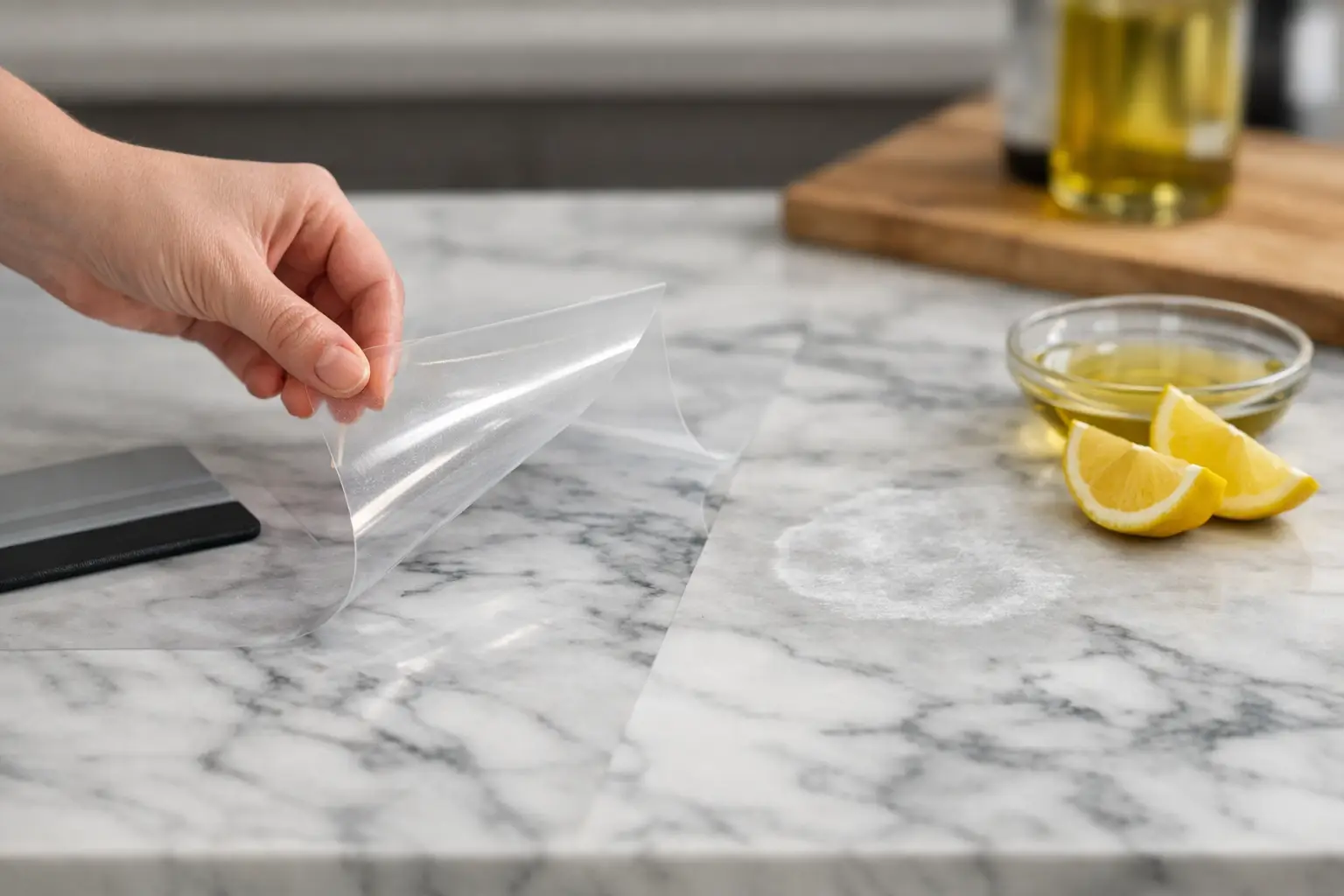
A marble vanity can look immaculate at handover and noticeably tired a year later. Toothpaste, skincare, vinegar, citrus, coffee and ordinary daily use can leave dull spots and rings that cut through the polished finish. That is why anti etch film for marble has become a serious consideration for property owners who want the elegance of natural stone without the constant anxiety of surface damage.
Marble is prized for depth, movement and natural variation, but it is also a calcium-based stone. That means it reacts to acidic substances. Sealing helps with some forms of staining, but it does not stop etching. This distinction matters. Many owners assume a freshly sealed marble surface is fully protected, only to discover that a splash of lemon juice or bathroom product still leaves a permanent mark in the finish.
An anti-etch film changes that equation by creating a protective barrier over the stone itself. Rather than relying on the marble to withstand daily exposure, the film takes the wear. For high-use interiors, that can be the difference between preserving a premium appearance and booking repeat restoration far sooner than expected.
What anti etch film for marble actually does
Anti etch film for marble is a clear protective surface layer designed to shield stone from etching, light scratching, staining and general day-to-day wear. It is typically applied to benchtops, bathroom vanities, bar tops, reception counters and other presentation-critical surfaces where marble is exposed to liquids, cosmetics, food acids or frequent contact.
The key benefit is that the film sits above the marble finish. If acidic products land on the surface, they interact with the film rather than chemically attacking the stone. That is especially valuable in kitchens and bathrooms, where even careful owners cannot control every spill or splash.
A quality installation aims to preserve the visual character of the marble while making the surface easier to live with. The best result is not a plastic-looking overlay. It is a refined, discreet protective layer that allows the stone’s veining and elegance to remain the focal point.
Why marble etches so easily
Etching is not the same as staining. A stain happens when a substance penetrates the stone and discolours it. Etching is surface corrosion caused by acid reacting with the calcium carbonate in marble. It appears as dull patches, cloudy marks or light rings that disrupt the polish.
This is why marble in bathrooms often deteriorates faster than expected. Products such as cleansers, serums, shaving foam and hair products can be surprisingly aggressive. In kitchens, wine, fruit, sauces and common cleaning sprays all pose a risk. Even when the stone is expensive and professionally finished, its chemistry stays the same.
For some owners, that patina is acceptable. In heritage or low-traffic settings, natural ageing can suit the character of the space. But in contemporary homes, luxury apartments, hotel bathrooms and polished commercial interiors, ongoing etching usually reads as damage rather than charm.
Where anti-etch film makes the most sense
Not every marble surface needs film, and that is where professional advice matters. The strongest case is usually for horizontal surfaces that see daily contact and visible use. Kitchen benchtops, island tops, vanities and bar surfaces benefit most because they are exposed to spills, product residue and frequent wiping.
Commercial environments can gain even more value. A marble reception desk or washroom vanity in a hospitality or retail setting needs to hold its finish under much heavier traffic than a private home. In those situations, protection is not only about appearance. It is about reducing maintenance cycles and avoiding premature restoration costs.
Floors are a different conversation. While some protective solutions suit flooring, anti-etch film is generally more relevant to benchtops and similar surfaces where acid exposure is the main issue. Selection should always be based on actual use, not just the type of stone.
The trade-offs to understand before installation
A premium finish deserves a clear-eyed recommendation, not a sales pitch. Anti-etch film offers strong practical benefits, but it is not a magic shield and it is not right for every client.
The first consideration is appearance. High-quality films are designed to be discreet, but any added layer can alter the surface slightly in sheen, reflectivity or tactile feel. On some marbles this difference is minimal. On others, especially highly polished and heavily lit surfaces, a trained eye may notice a change.
The second is lifespan. Film is a sacrificial protective layer, which means it is expected to absorb wear over time. In a busy kitchen or commercial fit-out, it may eventually need replacement. That is still often more cost-effective than repeated stone honing and polishing, but it should be seen as a maintenance strategy rather than a once-and-forget treatment.
The third is installation quality. Marble is a premium material, and poor application will show. Trapped dust, misaligned edges, bubbling or rushed finishing can undermine the look of the surface and the value of the protection. Product quality matters, but installer expertise matters just as much.
Anti etch film for marble versus sealing
This is one of the most common points of confusion. Sealing and anti-etch film do different jobs.
A penetrating sealer is designed to slow the absorption of liquids into the stone. It helps reduce the risk of staining from substances such as oil, wine or coloured spills, depending on the stone and sealer used. What it does not do is stop acid from etching the marble surface.
Anti etch film, by contrast, is intended to form a physical barrier between the marble and the source of damage. It addresses the limitation that sealers cannot solve. In many cases, the two approaches are complementary rather than competing. One protects from below the surface, the other from above.
For owners who have already restored etched marble, this distinction becomes especially important. Once you have invested in honing and polishing to bring the stone back to a high finish, it makes sense to consider how you will protect that result.
What to expect from professional installation
A proper installation starts well before the film is applied. The marble surface needs to be assessed for etching, scratches, residue, inconsistent polish and any existing coating issues. If the stone is already damaged, applying film over the top will not correct the defects. It will preserve what is underneath, for better or worse.
That is why restoration often comes first. The marble may need cleaning, honing, polishing or minor repair so the final surface is worthy of protection. Once prepared correctly, the film can be installed with far greater visual clarity and adhesion.
For Sydney properties, this is particularly relevant in premium residential and commercial spaces where lighting is unforgiving and finishes are expected to be precise. A craftsmanship-led installation should look intentional, neat and suited to the standard of the interior.
Is it worth it?
If your marble is mostly decorative and rarely touched, perhaps not. If it sits in a powder room used a few times a week, the risk profile is low. But if the surface is central to daily living or public presentation, the value becomes much clearer.
Anti-etch film is often worth considering when replacement would be expensive, disruption needs to be avoided, or the finish must stay consistently polished. That includes family kitchens, apartment bathrooms, hospitality venues and commercial premises where worn stone reflects poorly on the space as a whole.
The financial argument is straightforward. Marble restoration is far more economical than replacement, and protective film can help extend the life of that restored finish. For many owners, it is not just about preventing damage. It is about protecting the investment already made in premium stone.
At Grand Stone Restoration, this type of protection is best approached as part of the full lifecycle of stone care, not as an isolated add-on. The right recommendation depends on the condition of the marble, the location of the surface and how the space is actually used.
Marble will always be a material of elegance rather than indifference. If you want to enjoy that elegance without treating every splash as a disaster, the right protective system can make the surface far more practical while still letting the stone speak for itself.