
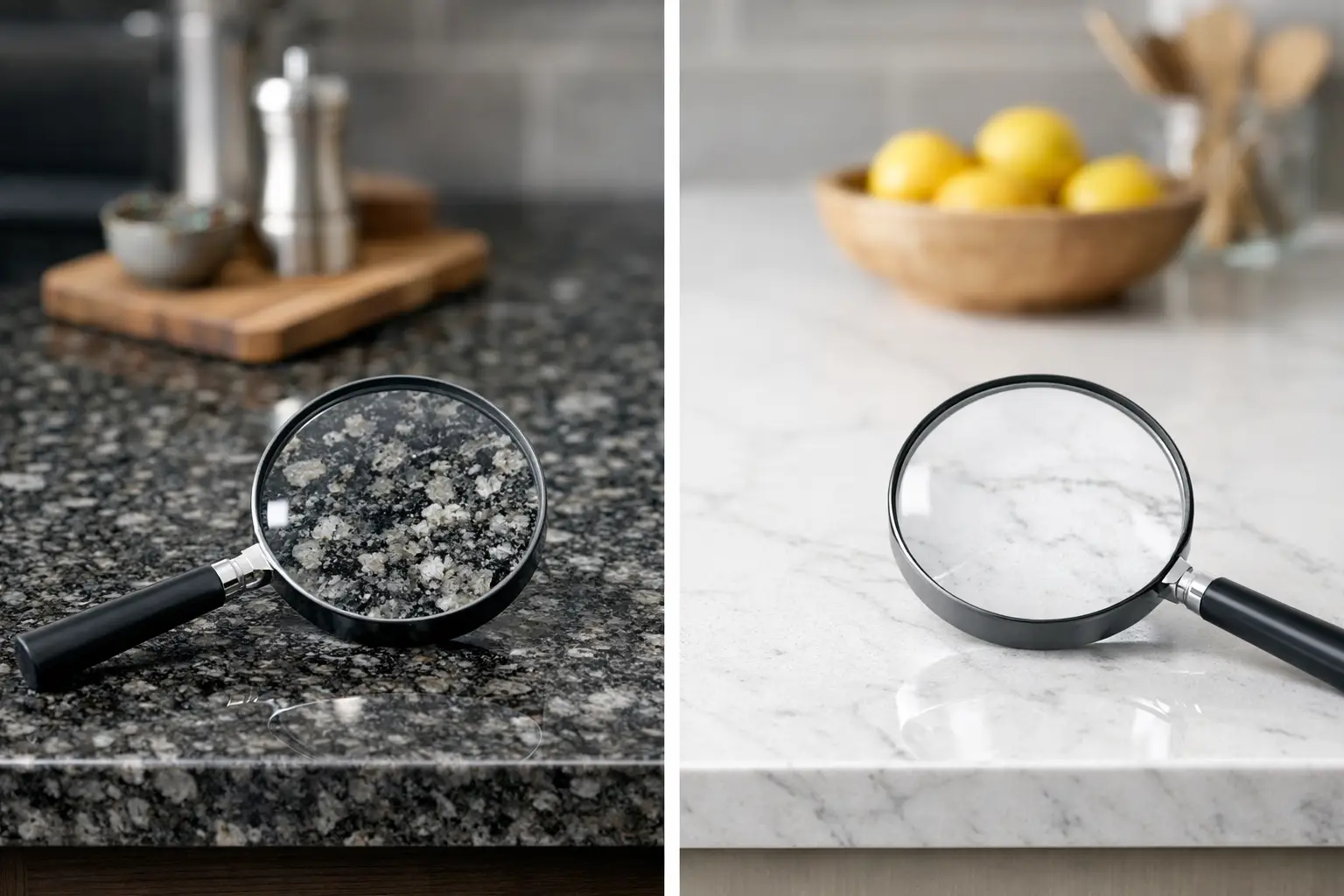
A benchtop can look exceptional on installation day and still disappoint within a few years if its material, finish and daily use were not properly considered. When choosing granite or quartz benchtops, the better option is rarely the one with the boldest showroom sample. It is the surface that suits your kitchen, your maintenance expectations and the way you want the room to age.
Granite brings the individuality of natural stone: every slab carries its own mineral movement, veining and depth. Quartz benchtops, commonly made from engineered stone, offer a more consistent and controlled appearance. Both can create a refined kitchen, but their performance, repair options and current Australian regulatory context are very different.
Granite or quartz benchtops: start with the material
Granite is a natural igneous stone cut from large blocks and fabricated into slabs. Its crystalline structure gives it remarkable hardness, natural variation and a visual depth that manufactured surfaces cannot precisely replicate. From understated black and grey granites to richly patterned materials with gold, green or blue mineral detail, granite has a substantial, enduring character.
Quartz benchtops generally refer to engineered stone. These products combine crushed quartz with resins, pigments and other additives to create a dense, uniform slab. They have long been selected for their broad colour range, predictable patterning and non-porous finish.
There is an important distinction for Australian property owners. The national prohibition on the use of engineered stone containing crystalline silica took effect in 2024. This affects the manufacture, supply and installation of many new engineered quartz benchtops. Requirements and exemptions can be complex, so anyone planning a new kitchen should obtain current, project-specific advice from a suitably qualified supplier or fabricator. Existing engineered stone benchtops can still be cleaned, maintained and, where suitable, professionally restored using controlled methods.
Do not confuse engineered quartz with quartzite. Quartzite is a natural stone, with its own performance profile and appearance, and is a completely different material.
The difference you will notice every day
Granite is highly resistant to scratching and heat. A hot pan is less likely to cause immediate damage than it would on a resin-bound engineered surface, although trivets remain sensible protection for any premium benchtop. Its hardness also makes granite well suited to busy family kitchens, entertaining areas and commercial food preparation spaces where durability matters.
Its trade-off is porosity. Even dense granite can absorb moisture or oils if it is not properly sealed, particularly around joins, cut-outs and frequently used preparation zones. A quality impregnating sealer reduces that risk without changing the stone’s natural character. Sealing is not a one-off promise of permanent protection; it should be assessed over time according to the stone, finish and use of the kitchen.
Engineered quartz has traditionally appealed because its resin-bound surface is relatively non-porous. Day-to-day spills are less likely to penetrate, and a consistent colour can make it easier to coordinate cabinetry, splashbacks and flooring. For households wanting a crisp, controlled aesthetic, this consistency is a genuine advantage.
However, engineered stone is not invulnerable. Heat can discolour or damage resin binders, harsh chemicals can dull the finish, and heavy impacts can chip edges or crack areas around sinks and cooktops. Dark colours and highly polished finishes can also reveal scratches, residue and fingerprints more readily than homeowners expect.
Appearance: natural variation versus controlled design
The visual decision is often emotional, and rightly so. A granite slab is not repeated elsewhere. It may contain dramatic mineral flecks, fine grain, flowing movement or subtle tonal shifts that become a defining feature of the kitchen. In premium homes, granite can lend a sense of permanence that improves with considered design and proper care.
Quartz delivers a more uniform result. That can be ideal where cabinetry lines are minimalist, large runs need to match closely, or a particular colour is central to the design brief. Some engineered surfaces imitate marble convincingly from a distance, but natural stone rewards closer inspection with greater depth and irregularity.
Neither look is automatically superior. A quiet, contemporary apartment kitchen may suit a consistent engineered finish, while a substantial family home, heritage renovation or statement entertaining space may benefit from granite’s authentic variation. The key is to view full slabs wherever possible, not just small samples under showroom lighting.
Cleaning and protection are where value is preserved
The best benchtop care is uncomplicated: wipe spills promptly, use a pH-neutral stone cleaner where appropriate, and avoid abrasive powders, scouring pads, strong bleach and acidic products. Lemon juice, vinegar and aggressive kitchen cleaners may not damage granite in the same way they would marble, but they can still compromise sealers and leave residues that reduce the surface’s lustre.
Granite benefits from periodic professional assessment. If water no longer beads on the surface, or darker marks appear temporarily after wetting, the sealer may be losing effectiveness. Professional cleaning and resealing can restore reliable protection while retaining the stone’s natural finish.
Existing quartz or engineered stone surfaces should also be cleaned gently. Avoid placing hot cookware directly onto the benchtop, and do not use oven cleaner, paint stripper, caustic products or harsh solvents. Stubborn marks should be assessed before stronger chemicals are applied. A well-intended DIY fix can turn a small blemish into a larger dull patch.
Chips, scratches and stains: which is easier to restore?
Granite has a strong advantage in long-term restoration potential. Chips can often be colour-matched and filled, surface scratches may be refined, and worn or uneven areas can be professionally honed and polished. Results depend on the stone’s colour, grain, finish and the location of the damage, but skilful restoration can avoid the cost and disruption of replacing an otherwise sound benchtop.
Engineered stone can also be repaired in certain situations, especially for small chips, scratches and isolated marks. Yet repairs can be more visually challenging on heavily patterned, glossy or very light surfaces. The resin matrix, pigment blend and manufactured pattern all affect how discreet a repair can be. Heat damage, deep cracks and widespread surface dullness may require a more cautious assessment.
For either material, the most successful repairs begin with accurate identification. A specialist should determine whether the surface is natural granite, engineered stone, quartzite or another composite before selecting abrasives, fillers, sealers or polishing compounds. One treatment does not suit every slab.
Cost should include the years after installation
Upfront pricing is only part of the comparison. Granite may involve slab selection, fabrication complexity and ongoing sealing, but it can deliver decades of service when properly maintained. Its ability to be professionally restored is particularly valuable for homeowners who see their kitchen as a long-term asset rather than a short-term fit-out.
Historically, quartz was often selected for predictable supply and lower maintenance. For a new project, Australia’s engineered stone rules now change that decision significantly. Beyond compliance, buyers should consider how a surface will respond to heat, edge impacts, daily cleaning and future repair needs.
A benchtop that can be cleaned, repaired and protected rather than replaced offers a better lifecycle outcome. This is especially relevant in Sydney properties where a kitchen renovation can involve apartment access restrictions, strata requirements, lengthy lead times and considerable disruption.
Make the choice with the full room in mind
Choose granite when you value natural beauty, excellent heat and scratch resistance, and the prospect of long-term restoration. It is a compelling option for kitchens where individuality and enduring material quality matter, provided you are prepared to maintain its protective sealer.
For an existing quartz benchtop, focus on preserving what is already installed. Gentle cleaning, sensible heat protection and timely attention to chips, dullness or staining can extend its useful life and keep the room looking polished. Before assuming replacement is necessary, a professional surface assessment may reveal practical restoration options.
The finest kitchens are not defined by a flawless sample board. They are defined by surfaces that continue to look considered, cared for and elegant after years of real use.