
A granite benchtop should feel smooth, look even under natural light and hold a rich, reflective finish without appearing greasy or coated. Knowing how to polish granite benchtops starts with recognising the difference between routine cleaning, restoring shine and repairing genuine surface wear. Granite is exceptionally hard, but it is not immune to scratches, dull traffic patterns around sinks, residue buildup or loss of clarity in its finish.
For a premium kitchen, the goal is not simply to make the stone shiny for a day. It is to restore a clean, refined surface that complements the investment made in the rest of the room.
What polishing granite actually does
Granite polishing improves the stone’s surface clarity and reflection. On a polished granite benchtop, this is achieved by refining the surface with progressively finer diamond abrasives until it reflects light evenly. Professional polishing may also involve specialist compounds, but the result comes primarily from careful mechanical refinement rather than a bottle of countertop polish.
This distinction matters. A spray polish can temporarily deepen the colour or create a slippery film, particularly if residue has built up over time. It cannot remove scratches, flatten uneven wear or restore the original factory sheen where the stone itself has become dull.
Granite also varies considerably. A dark, dense black granite may show fingerprints, streaking and fine scratches more readily than a lighter, heavily patterned stone. Some benchtops have a high-gloss finish, while others are honed, leathered or flamed. A honed finish should look soft and even, not mirror-like, so attempting to create a high gloss can alter its intended character.
Before you polish granite benchtops, identify the problem
A benchtop that appears dull is not always in need of polishing. In many Sydney kitchens, the issue is residue left by cleaning sprays, dishwashing liquid, cooking oils or hard-water minerals around the sink. These contaminants interfere with light reflection and can make an otherwise sound polished surface look patchy.
Start by cleaning a small area with a pH-neutral stone cleaner and a clean microfibre cloth. Wipe again with fresh water, then dry it thoroughly with another cloth. If the clarity returns, the benchtop needs a better maintenance routine rather than abrasive work.
If a dull mark remains after cleaning, inspect it closely. A cloudy patch may be surface residue. A rough area may indicate mineral deposits, while a fine network of lines may be scratches. A darkened patch that persists can suggest moisture or oil absorption, particularly where the sealant has worn thin. Each issue requires a different treatment, and treating all of them as a polishing problem can create unnecessary damage.
A simple water test for sealant performance
Place a few drops of water on a discreet section of the benchtop and leave them for several minutes. If the water beads up, the sealer is still providing reasonable protection. If the stone darkens or absorbs the water quickly, it may be time to reseal after the surface has been properly cleaned and restored.
Sealing does not make granite stain-proof, nor does it restore shine. It slows absorption and gives you more time to wipe up spills before they penetrate the stone.
How to polish granite benchtops for routine shine
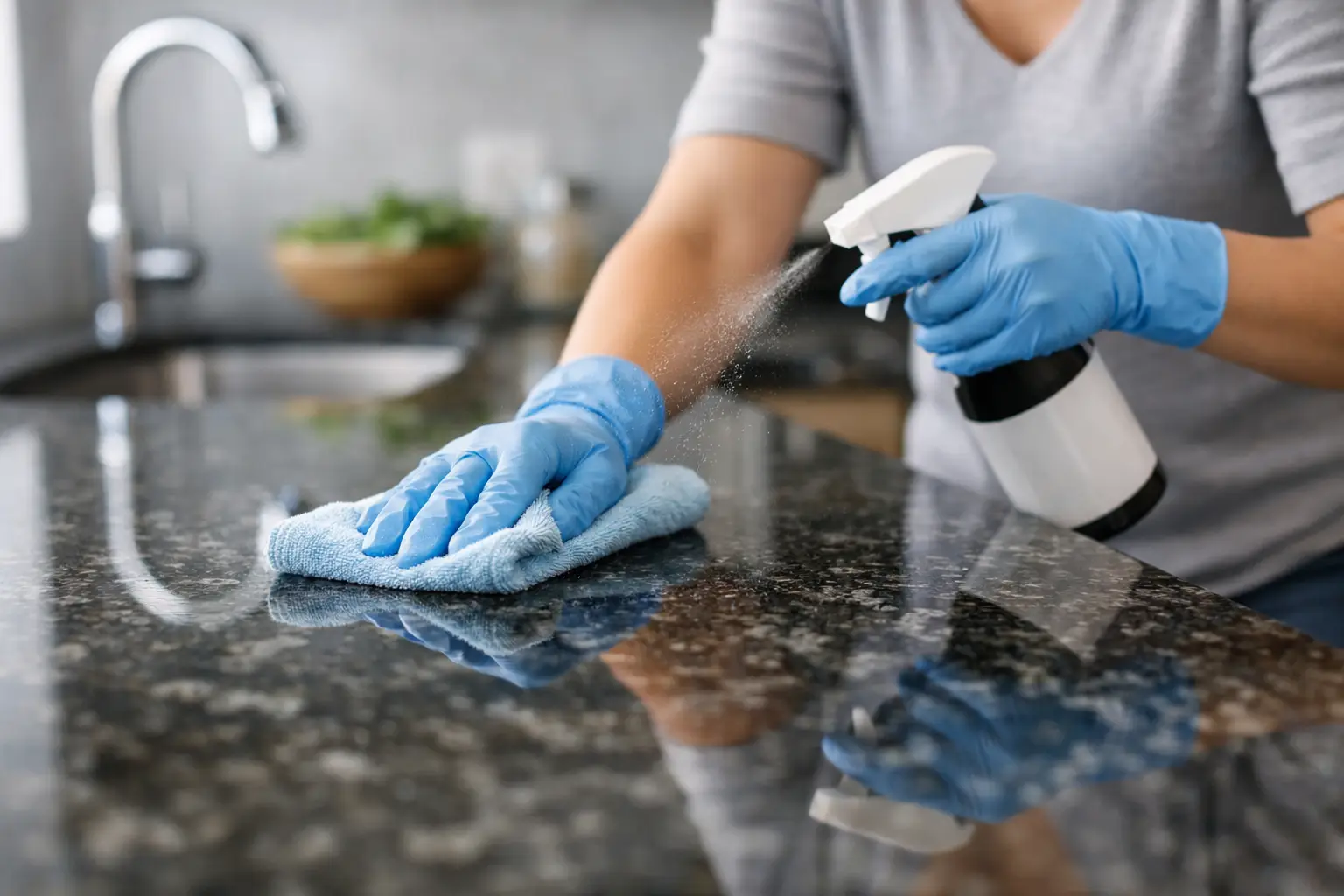
For regular care, gentle cleaning is the safest way to preserve a polished granite finish. Remove crumbs and grit first, as abrasive particles can cause fine scratching when dragged under a cloth. Then use a pH-neutral stone cleaner according to its directions and wipe with a soft microfibre cloth.
Rinse away cleaner residue with a lightly damp cloth and dry the surface immediately. Drying is a small but valuable step: it prevents water spotting and reveals whether the finish is genuinely clean. Buff gently with a dry microfibre cloth using overlapping passes rather than concentrated pressure in one spot.
Avoid vinegar, lemon juice, bathroom cleaners, bleach-based products, abrasive cream cleansers and scouring pads. Granite is more acid-resistant than marble, but harsh products can still attack the resin in some engineered or repaired areas, degrade sealers and leave a streaky, lifeless appearance. Similarly, generic silicone or wax polishes often leave a film that attracts dust and makes future restoration more difficult.
For a well-maintained benchtop, this cleaning and drying process is usually all that is needed to retain its natural lustre.
When a DIY polish is appropriate
A granite-specific polishing product can be useful where the stone is fundamentally sound and you want a modest improvement in gloss after deep cleaning. Choose a product designed specifically for natural granite, test it in an inconspicuous area and use only a small amount. Apply with a soft pad or microfibre cloth, following the manufacturer’s instructions precisely, then buff away all residue.
The trade-off is that topical products provide a cosmetic lift, not a permanent restoration. Overapplication can create smears, cloudy patches or an artificial-looking surface, especially on darker granite. If the benchtop needs repeated applications to look presentable, the issue is likely beneath the surface and warrants a professional assessment.
Never use a random power tool with an aggressive pad. Granite restoration uses purpose-selected diamond pads, controlled water management and a sequence tailored to the stone’s hardness, colour and existing finish. A poorly chosen abrasive can leave swirl marks or uneven gloss that is far more difficult to correct than the original problem.
When professional granite polishing is the better choice
Professional restoration is the appropriate path when the benchtop has visible scratches, dull areas that cleaning will not resolve, uneven reflection, persistent staining or damage around cut-outs and sink edges. It is also the sensible option for large island benches, premium dark granite and stone with a high-gloss finish, where even minor inconsistencies become conspicuous in daylight.
A specialist begins by assessing the stone itself, rather than applying a standard cleaning method. The surface may need deep cleaning and decontamination, localised scratch removal, honing to level the finish, then progressive polishing to rebuild clarity. Once the correct sheen is achieved, a quality impregnating sealer can be applied where appropriate to support long-term stain resistance.
This work is measured and material-specific. Taking too much from the surface can alter profiles, soften edges or leave the repaired area brighter than the surrounding stone. The right approach protects both the visual elegance and the long-term value of the benchtop.
At Grand Stone Restoration, granite treatment is tailored to the condition and finish of the individual surface. That precision is particularly valuable where restoration must blend seamlessly with surrounding splashbacks, stone islands or adjoining floors.
Protecting the finish after polishing
The best way to extend a restored finish is to minimise the wear that causes it to lose clarity. Use chopping boards rather than cutting directly on stone, wipe oils and coloured liquids promptly, and place protective mats beneath heavy appliances or decorative pieces that are moved regularly.
Do not leave wet cloths, cleaning bottles or metal containers sitting around the sink. Moisture can create water marks, and some metal bases can leave rust stains that require specialist removal. For everyday cleaning, pH-neutral products and dry microfibre cloths are more effective than harsh chemicals used infrequently.
Resealing schedules depend on the granite, its location and how the kitchen is used. A busy family kitchen may require more frequent attention than a lightly used apartment benchtop. Rather than resealing on a fixed timetable, monitor the water-bead test and act when the stone begins to absorb moisture more readily.
A refined finish is built, not sprayed on
Granite can retain its elegance for decades when it is cleaned correctly and restored with the right technical process. If your benchtop still looks flat after a careful clean, or scratches and patchy shine are distracting from an otherwise beautiful kitchen, professional polishing offers a considered alternative to replacement. A properly restored surface brings back the depth, clarity and lasting brilliance that granite was selected for in the first place.