
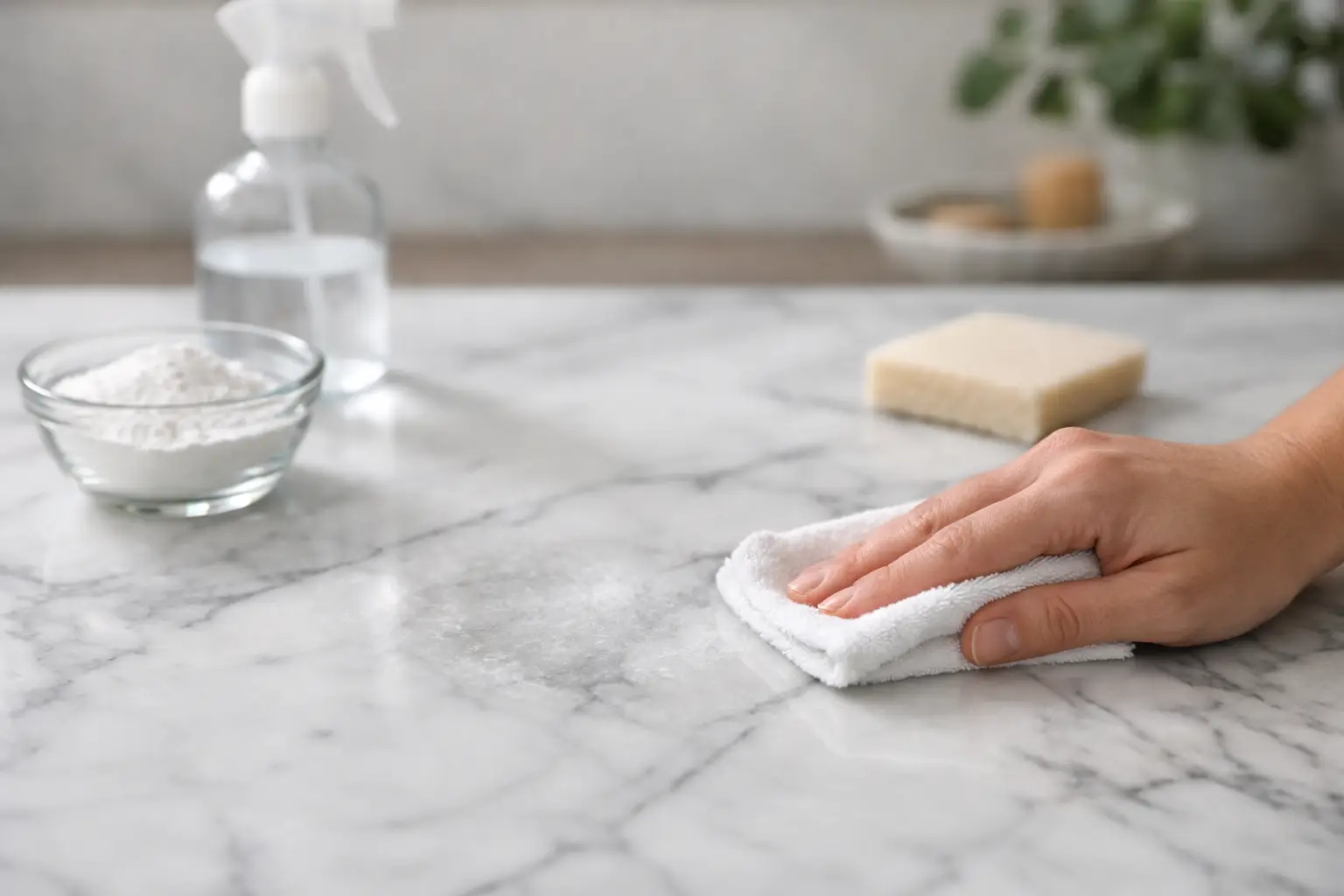
A marble vanity can look immaculate one day and tired the next, all because of a splash of lemon juice, a skincare product, or the wrong bathroom cleaner. If you need to remove etch marks from marble, the first thing to understand is that etching is not the same as staining. That distinction matters, because the right fix depends on what has actually happened to the stone surface.
Marble is a calcium-based natural stone. It reacts with acidic substances, and that reaction changes the surface itself. The result is usually a dull patch, a pale ring, or a cloudy area that catches the light differently from the rest of the stone. In premium interiors, even minor etching stands out immediately because it interrupts the clean, reflective finish that makes marble so desirable in the first place.
What etch marks on marble really are
An etch mark is surface damage caused by acid or harsh chemistry. Common triggers include citrus, vinegar, wine, coffee, toiletries, bathroom products, some multipurpose sprays, and descalers. On polished marble, etching appears as a dull spot because the acid has microscopically roughened the finish. On honed marble, it may show up as a darker or lighter patch rather than a shiny dull spot, which can make it harder to diagnose.
This is why many property owners try to clean the mark harder and get nowhere. Etching is not sitting on top of the marble. It is in the finish. No standard cleaner will restore the original sheen once the surface has been chemically altered.
That also explains why sealing is often misunderstood. A sealer can help reduce staining by slowing absorption, but it does not make marble acid-proof. If acidic products touch the surface, etching can still occur even on sealed stone.
Can you remove etch marks from marble yourself?
Sometimes, yes. Sometimes, no. The deciding factors are the depth of the etch, the finish of the marble, the size of the affected area, and how uniform you need the final result to be.
A very light etch on a small polished surface may respond to a marble polishing powder or a specialist marble etch remover designed for calcium-based stone. These products work by refining and re-polishing the surface. Used correctly, they can improve minor damage.
The risk is that DIY treatment often creates a new inconsistency. One patch becomes glossier than the surrounding stone, or the repaired section blends poorly under natural light. On benchtops, bathroom vanities, entry floors, and feature stone in high-visibility areas, that mismatch is often just as frustrating as the original mark.
If the marble is heavily etched, scratched as well as etched, or part of a larger continuous surface, professional honing and polishing is usually the more reliable path.
How to remove etch marks from marble at home
If you are dealing with a small, light etch and want to try a careful at-home approach, restraint is critical. Marble rewards precision, not aggression.
Start by cleaning the area with a pH-neutral stone cleaner and a soft microfibre cloth. This removes residue so you can see the true extent of the damage. Dry the surface completely and inspect it from different angles. If the mark still looks dull, cloudy, or flat compared with the surrounding finish, it is likely etched.
Next, use a marble-specific polishing compound or etch-removal product exactly as directed. Avoid general polishing creams, bathroom abrasives, or anything marketed for broad household use. Apply only to the affected area at first, using a soft cloth or pad as recommended by the manufacturer. Work gently and check the finish often.
If the marble begins to improve and the sheen is blending well, you may be able to restore a small isolated mark. If there is little change, or if the finish becomes uneven, stop there. Continuing usually enlarges the problem and can make professional correction more involved.
What you should not do is just as important. Do not use vinegar, baking soda pastes, bleach, gumption-style abrasives, magic erasers, or generic tile polish. These shortcuts often strip more finish, create haze, or scratch the marble further.
When professional marble restoration is the better option
There is a point where etching moves beyond spot treatment. Large patches, widespread bathroom etching, acid damage around sinks, ring marks on dining tables, and dull traffic lanes on marble floors all benefit from professional restoration methods rather than localised DIY repair.
A specialist will assess the stone type, the finish, and the extent of the damage before selecting the right process. That may involve light honing to remove the etched layer, followed by polishing to restore clarity and reflectivity. On honed marble, the goal may be an even matte or satin finish rather than a high gloss. On polished marble, the work is about recovering depth, brilliance, and uniformity across the entire surface.
This is where craftsmanship matters. Marble restoration is not simply making a patch shiny again. It is about matching the original character of the stone and producing a finish that looks intentional, balanced, and premium across the full area.
For many homeowners and commercial property managers, restoration is also the more economical decision. Replacement is expensive, disruptive, and often unnecessary when the stone itself is structurally sound. Surface correction can revive the existing marble at a fraction of that cost while preserving the elegance of the original installation.
Why some etch marks keep coming back visually
In many cases, the etch has been partly improved but not fully levelled with the surrounding finish. Under overhead lighting, sunlight, or raking light from a window, the damaged section still refracts differently. This is common after home spot polishing or inconsistent previous repair work.
The issue can also be compounded by surrounding wear. If one section of marble has dulled over time while another area has been freshly polished, the contrast becomes obvious. That is why whole-surface treatment often delivers a better visual result than isolated repair, especially on open benchtops, bathroom vanities, hotel surfaces, and lobby floors.
A tailored approach is essential. Not every marble responds the same way. Softer stones etch more readily. Some finishes highlight damage more than others. The right treatment is always stone-specific.
Preventing future etching without losing the luxury look
Once marble has been restored, protection becomes the next priority. Good day-to-day care helps preserve the finish and reduce repeat damage.
Use only pH-neutral cleaners made for natural stone. Wipe acidic spills quickly, especially citrus, wine, vinegar-based products, and bathroom toiletries. Keep harsh cleaners away from marble splashbacks, vanities, shower shelves, and floors. Coasters, trays, and protective placement around sinks make a real difference on polished surfaces.
For higher-risk environments, additional protection may be worth considering. Professional sealing supports stain resistance, while protective surface treatments or anti-etch film can be appropriate in some residential and commercial settings where marble is exposed to frequent chemical contact. The best option depends on how the space is used and how much maintenance tolerance the owner has.
This is particularly relevant in busy Sydney homes, apartment bathrooms, office amenities, and hospitality venues where presentation matters but surfaces also take daily wear. A beautiful finish is only part of the result. Long-term performance matters just as much.
The smartest way to deal with etched marble
If the damage is faint and isolated, a careful DIY attempt may be reasonable. If the marble is valuable, highly visible, or broadly affected, professional restoration is the safer choice. The cost of getting it right the first time is often far less than the cost of chasing failed fixes, creating uneven sheen, or replacing stone that could have been restored.
At its best, marble brings light, depth, and quiet luxury to a space. Etching dulls that effect, but it does not always mean the surface is beyond repair. With the right treatment, even tired marble can be brought back to a refined, elegant finish that looks worthy of the room around it.
If you are weighing up whether a mark is superficial or whether the surface needs full correction, trust what the light is showing you. Marble tells the truth in reflection, and a well-restored finish is unmistakable.