
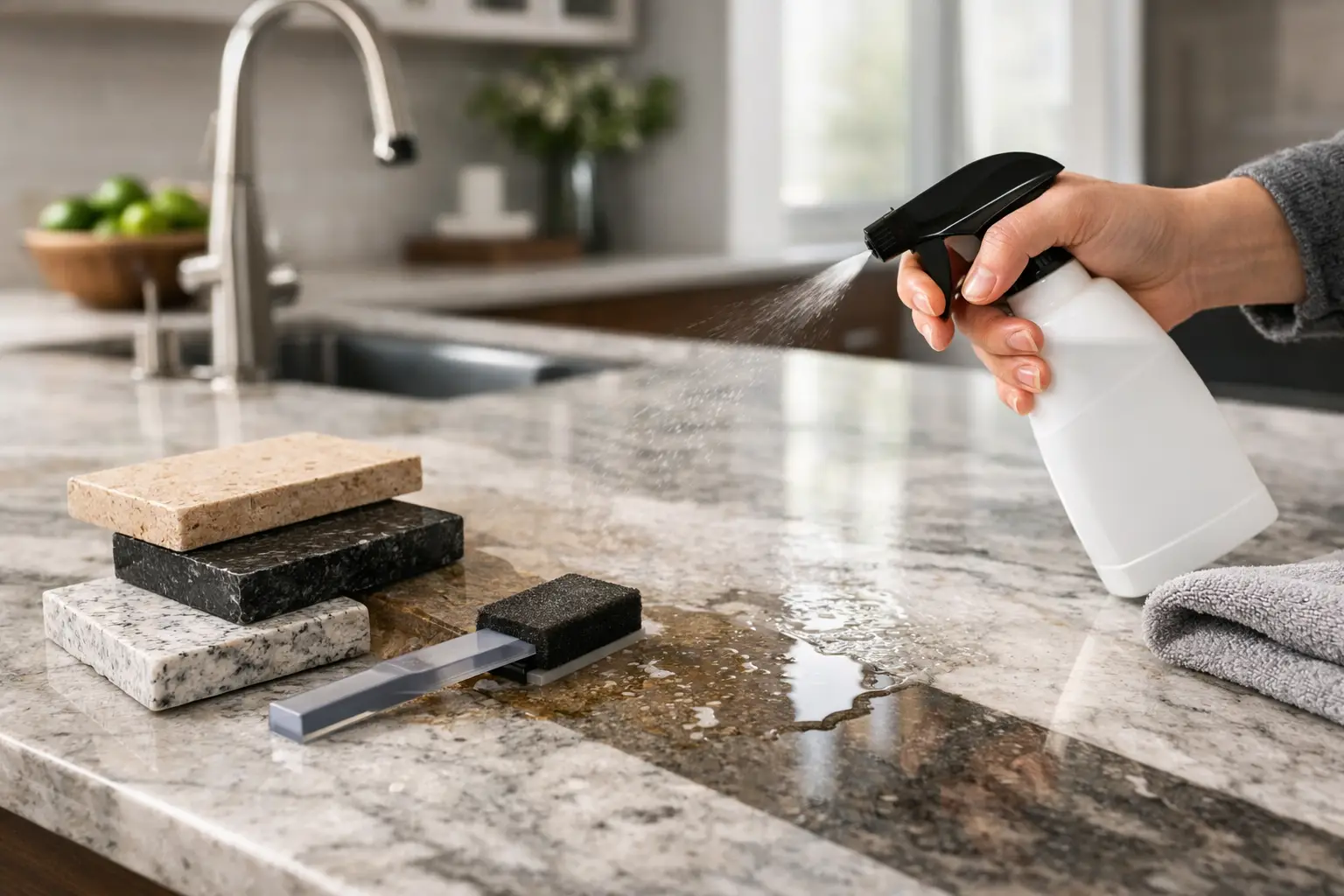
A kitchen benchtop can look immaculate at installation, then lose its lustre through everyday cooking, cleaning and spills. The best stone sealer for kitchens is not a single product chosen from a shelf. It is the sealer that suits the exact surface, its finish, its condition and the way the kitchen is used.
That distinction matters. A penetrating sealer can help resist oil and food stains on porous natural stone, but it will not prevent acidic liquids from etching polished marble. A coating that appears to add shine may alter the appearance of a honed limestone floor or leave a kitchen surface harder to maintain. Premium stone deserves a treatment selected with the same care as the stone itself.
What a kitchen stone sealer should do
A quality kitchen sealer is designed to reduce the rate at which liquids and oils enter a porous surface. On an unsealed or poorly sealed benchtop, olive oil, turmeric, red wine, coffee and food preparation residue can penetrate beneath the surface, creating dark patches that are difficult to remove without professional restoration.
Most high-quality sealers used on natural stone are penetrating or impregnating sealers. Rather than sitting as a visible layer on top, they enter the pores and line them with a protective treatment. This allows the stone to retain its natural character while providing more time to wipe up spills before they become stains.
The right result should be subtle. Stone should still look like stone – not plastic, overly glossy or coated. For refined interiors, this invisible protection is usually preferable to a topical film that can wear unevenly, trap moisture or change the surface’s original colour and texture.
Sealing is valuable protection, but it is not a licence to leave spills sitting on the benchtop. It improves stain resistance; it does not make a porous stone completely stain-proof, scratch-proof or acid-proof.
The best stone sealer for kitchens depends on the surface
Marble and limestone
Marble and limestone are elegant choices for kitchens, particularly on islands, splashbacks and feature benchtops. They are also calcareous stones, meaning they react with acids. Lemon juice, vinegar, wine and many household cleaners can cause etching – a dull or lighter mark created when acid changes the surface itself.
For these stones, a premium impregnating sealer is generally the correct approach for helping with oil and pigment staining. Choose a breathable, food-area-appropriate treatment that does not create a heavy surface layer or artificially darken the stone unless an enhanced appearance is specifically desired.
However, sealing will not stop etching. Where a polished marble benchtop is used intensively, an anti-etch protective film may be worth considering. It provides a more direct barrier against the etching, scratching and wear that sealers alone cannot prevent, while preserving the appearance of the stone beneath. The right solution depends on the client’s preferred finish, tolerance for natural patina and daily kitchen habits.
Granite and quartzite
Granite and quartzite are often selected for their durability, but their density can vary considerably. Some slabs absorb very little, while others have more open pores, fissures or mineral movement that benefit from sealing. A water test can offer an initial indication, although it is not a substitute for assessing the specific stone and its existing treatment.
A penetrating, stain-resistant sealer is usually the preferred choice for granite and quartzite benchtops. It should protect without leaving residue or affecting the polished, honed or leathered finish. Even highly durable stone can be marked by oils or coloured liquids if neglected, so a properly matched sealer remains worthwhile.
Travertine, sandstone and other porous natural stone
Open-textured stones need particularly careful attention in a kitchen. Travertine, sandstone and some limestones can absorb liquids quickly, especially where there are natural pits, veins or filled areas. These surfaces often require a professional-grade impregnating sealer with strong resistance to water- and oil-borne staining.
An enhancing sealer can deepen colour and enrich the texture of some honed or tumbled stones. That can be an attractive result, but it is a design decision, not a default. Enhancement is difficult to reverse, and the appearance should always be tested in a discreet area before treating an entire floor or benchtop.
Engineered stone and porcelain
Engineered stone products such as Caesarstone and Silestone are generally non-porous and normally do not require sealing. Applying a conventional natural-stone sealer to these surfaces can leave streaks, haze or a residue that attracts grime rather than improving protection.
Porcelain kitchen benchtops and tiles are similarly dense. The tiles themselves rarely need sealing, although grout joints may benefit from a suitable grout sealer. In these cases, correct cleaning methods and repair of chips, scratches or damaged grout are more valuable than adding an unnecessary coating.
Avoid the wrong kind of protection
The most common sealer mistake is treating every stone as though it behaves the same way. Another is choosing a product based solely on marketing claims such as “wet look”, “high gloss” or “ultimate protection”. In a kitchen, appearance, food preparation, slip resistance for floors and ongoing maintenance all need to be considered.
Avoid products that form a thick, shiny coating on polished natural stone unless they have been specified for that exact purpose. These coatings can peel, scuff, yellow or create an uneven finish as they wear. They may also conceal a deeper issue, such as etching, dull traffic areas or ingrained staining, rather than restoring the stone properly.
Acidic cleaners should also stay out of the kitchen stone-care routine. Vinegar, lemon-based products, bathroom cleaners and many supermarket sprays can damage marble, limestone, travertine and grout. Use a pH-neutral stone cleaner and a soft cloth for benchtops, then dry the surface rather than allowing cleaner residue to sit.
How to tell whether kitchen stone needs resealing
The simplest check is to place a few drops of water on a clean, dry surface in an inconspicuous area. If the water remains beaded for several minutes, the existing protection may still be performing well. If it darkens the stone quickly as it absorbs, the surface may be due for resealing.
This test is only a guide. Water absorption does not reveal oil resistance, and a surface can appear adequately sealed while still showing old stains, etching or wear. Stone that has become dull, patchy or difficult to clean may need professional honing, polishing or deep cleaning before a new sealer is applied. Sealing over contamination or failed coatings rarely produces a premium result.
For busy kitchens, resealing frequency varies from roughly one to several years depending on the stone, the sealer quality, cleaning practices and exposure. A lightly used quartzite island will not wear at the same rate as a marble benchtop in a family kitchen or a natural-stone floor in a hospitality venue.
Professional sealing protects the finish, not just the surface
Professional sealing begins with preparation. The stone must be assessed for stains, etching, scratches, grout damage, failed coatings and previous sealers that may interfere with adhesion or absorption. It is then cleaned and, where required, restored to an even finish before the appropriate treatment is applied in controlled quantities.
Excess sealer left on the surface can cure into streaks or cloudy patches, particularly on polished stone. Uneven application can also create inconsistent colour on porous materials. A specialist understands how each material absorbs treatment, how long it should dwell and how to remove residue without compromising the finish.
For Sydney homeowners and commercial property managers, this approach can extend the life and visual impact of high-value stone without the disruption of replacement. Grand Stone Restoration assesses the stone first, then recommends restoration, sealing or protective film based on what will genuinely preserve its elegance.
Treat your kitchen stone as a finish worth protecting, not a problem to cover up. With the right sealer, careful cleaning and timely restoration when wear appears, a benchtop can retain the depth, clarity and quiet luxury that made it worth choosing in the first place.