
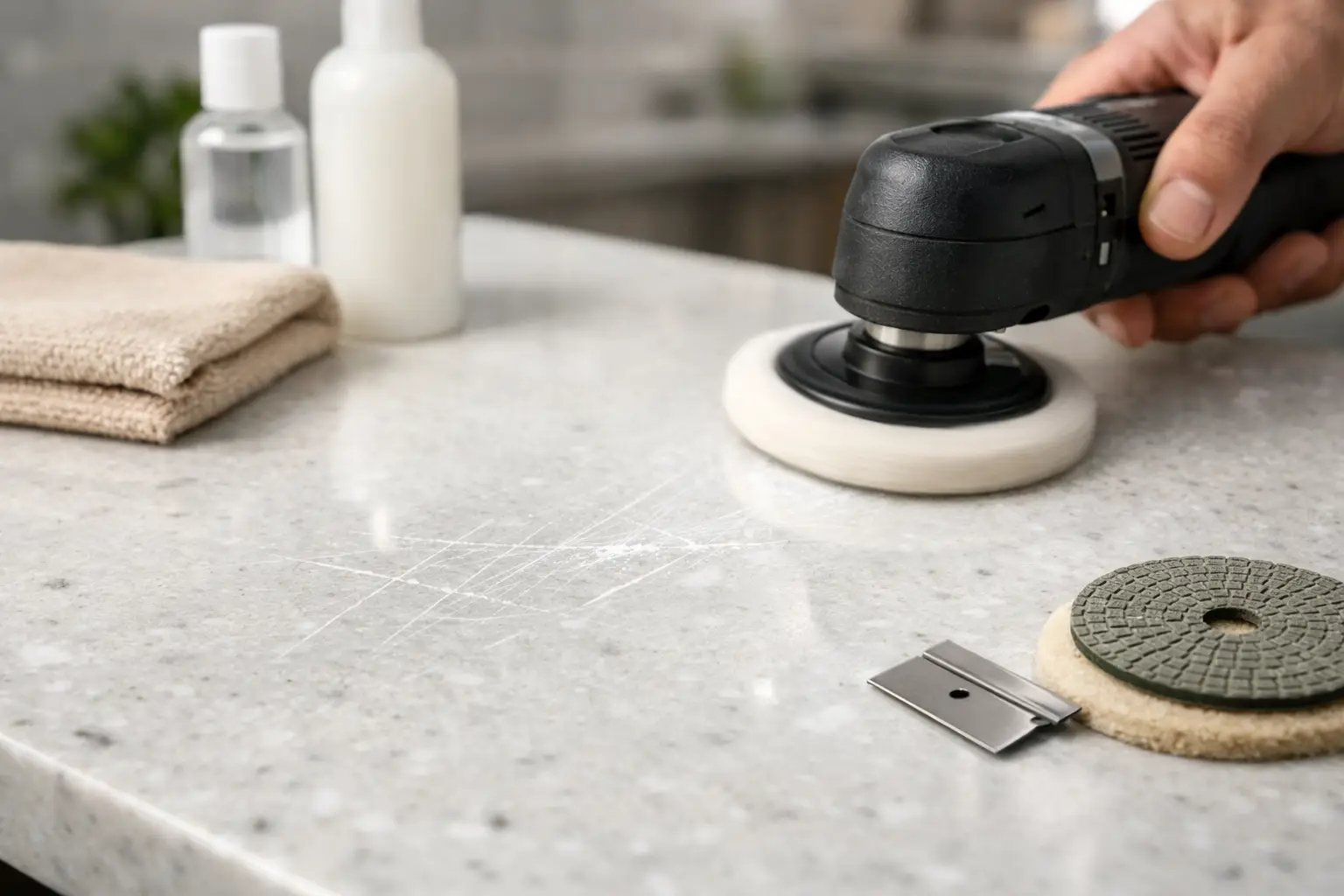
A scratch across a pale quartz benchtop can catch the light far more than expected. It can make an otherwise refined kitchen, bathroom vanity or commercial counter look worn before its time. So, can scratched quartz be repaired? In many cases, yes – but the right outcome depends on whether the mark is truly a scratch, how deep it is, and whether the surface is engineered quartz or natural quartzite.
Quartz is valued for its hard-wearing, polished appearance, yet it is not invulnerable. Dragged ceramics, abrasive cleaning pads, grit caught beneath an appliance, damaged tools or sharp metal edges can leave visible marks. Professional restoration can often reduce or remove surface scratching, blend repairs and recover a more even finish without the disruption and expense of replacement. The key is treating the exact material and damage, not applying a generic polishing method.
Can scratched quartz be repaired without replacement?
Light scratches and surface scuffs are usually the most responsive to restoration. A stone specialist can assess the area under direct light, identify the existing sheen and use controlled refinishing techniques to improve clarity and consistency. On a polished surface, this may involve carefully refining a local area before restoring the gloss so it blends with the surrounding stone.
The important qualification is that quartz is not restored in precisely the same way as marble. Marble is softer and can often be honed and polished with a relatively predictable response. Engineered quartz is a manufactured surface made from quartz aggregate, resin and pigments. Its finish, pattern and gloss level are created in production, which makes an invisible repair more technically demanding.
A good repair is therefore about more than making a line less obvious. It is about retaining an even reflection, avoiding a cloudy patch, preserving the colour around the damage and ensuring the repaired section does not look different from the rest of the benchtop. That is where material-specific experience matters.
First, establish whether it is actually a scratch
Not every mark on quartz has cut into the surface. Some are metal transfer marks from pots, utensils or appliance bases. Others are residue from cleaning products, paint, silicone or mineral deposits. These can resemble scratches but may sit on top of the surface, meaning they can often be removed without altering the finish.
A genuine scratch can usually be felt lightly with a fingernail or seen as a narrow disruption in reflected light. A deeper scratch may have a pale edge, collect dirt or reveal a change in texture. Chips and cracks are different again. They call for colour-matched resin repair and careful shaping rather than straightforward polishing.
An on-site assessment prevents an unnecessary or unsuitable treatment. Attempting to polish a transfer mark aggressively can dull the quartz. Treating a deep gouge as a superficial scratch may leave it visible and create an uneven gloss around it.
What professional quartz scratch repair involves
The best method depends on the surface, the damage and the desired finish. For fine abrasion, the restoration process may be limited to a controlled refinement and polish. The aim is to reduce the scratch while matching the surrounding lustre as closely as the material allows.
Where the scratch is deeper, a technician may need to level the affected area gradually, then rebuild the finish through progressively finer stages. If material has been removed from the surface, a clear or colour-matched repair resin can be used to fill the damaged line before it is shaped and blended. On patterned engineered stone, matching the repair to the surrounding veining or aggregate requires particular care.
This work should be carried out with appropriate dust control, wet methods where required and specialist equipment. Dry grinding or cutting engineered stone is not a DIY task. It can create hazardous crystalline silica dust and may also permanently damage the surface if handled incorrectly.
The final result is influenced by the original finish. Honed and matte quartz can be more forgiving because there is less reflection to match. Highly polished black, white or solid-colour quartz tends to reveal any variation in gloss, especially near windows, pendant lights and underbench lighting. A specialist may recommend treating a wider section of the benchtop rather than working only on the line itself, as this can produce a more natural visual transition.
When a scratch cannot be made completely invisible
Professional repair is often highly effective, but it should be approached with realistic expectations. A shallow scratch in a low-traffic area may be removed so well it is very difficult to find. A deep gouge beside a sink, on a waterfall edge or in the centre of a glossy dark island may remain faintly visible from certain angles, even after careful restoration.
The limitations come down to depth, colour, pattern and finish. If the scratch has cut through resin-rich areas or disturbed a prominent vein, removing enough material to erase it may create a shallow dish or alter the pattern. In that case, filling and blending the defect may deliver the better result.
Cracks also need a separate diagnosis. A crack around a cooktop cut-out, sink or join can indicate movement, inadequate support, heat stress or impact. Cosmetic repair alone will not address the underlying cause. The benchtop should be stabilised and the source of the stress considered before a finish repair is completed.
Natural quartzite deserves its own assessment as well. Although often referred to simply as quartz, quartzite is a natural stone with different minerals, porosity and fabrication characteristics. It may respond more like natural stone during honing and polishing, but its performance still varies significantly from slab to slab.
Why DIY scratch fixes often create a larger problem
Online advice frequently recommends abrasive creams, polishing compounds, sanding discs or household tools. These approaches can leave a visible dull spot, a circular haze or a patch with a different texture from the surrounding quartz. The original scratch may be less noticeable than the attempted repair.
Harsh cleaners are also a poor solution. While engineered quartz is generally stain resistant, strong solvents, highly alkaline products and abrasive powders can affect the resin binder, leaving the finish flat or discoloured. Bleach should not be used as a routine cleaner, and abrasive scourers should stay out of the cleaning cupboard.
For everyday care, use a soft microfibre cloth, warm water and a pH-neutral cleaner suitable for engineered stone. Wipe spills promptly, use chopping boards rather than cutting directly on the benchtop, and place trivets beneath hot cookware. Quartz is heat resistant to a degree, but sudden or concentrated heat can damage the resin matrix and contribute to cracking or discolouration.
Protecting the repaired finish
Once a quartz surface has been restored, prevention helps preserve the result. Protective measures are often simple: felt pads beneath decorative objects, care when moving small appliances, mats under heavy ceramics and prompt removal of grit from benchtops and vanities. On commercial counters, staff cleaning practices can make a substantial difference over time.
Not every quartz surface needs a sealer. Unlike many natural stones, engineered quartz is typically non-porous and does not benefit from traditional penetrating sealing in the same way. However, specialist protective treatments or coatings may be appropriate in particular high-use settings, depending on the product, finish and surface condition. The correct recommendation should follow an inspection, rather than a one-size-fits-all promise.
For Sydney property owners and managers, Grand Stone Restoration can assess scratched quartz alongside surrounding stone surfaces and recommend a tailored repair path. That may mean targeted refinishing, chip filling, broader surface restoration or, where damage is structural or beyond a worthwhile repair, clear advice on the most practical next step.
A scratched quartz surface does not automatically need replacing. Before accepting the cost and disruption of a new benchtop, have the damage assessed in the light where it is most visible. A precise, professionally matched repair can restore the polished appearance that made the surface worth choosing in the first place.