
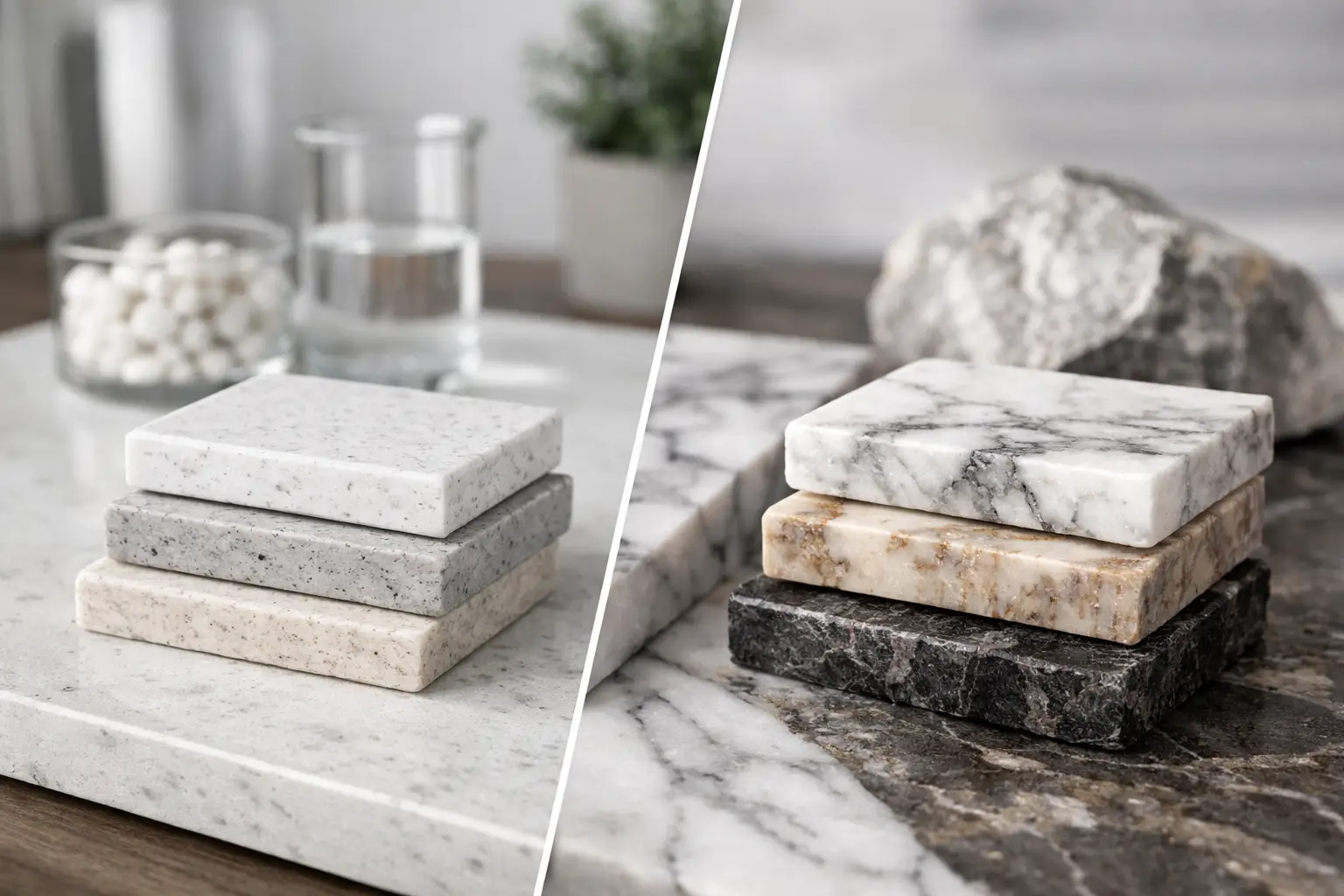
A polished kitchen island can look flawless on inspection day and tired just a few years later. That change usually has less to do with style than material choice. When weighing engineered stone vs natural stone, the right answer depends on how the surface will be used, what level of maintenance you accept, and how important repairability is over the long term.
For homeowners and property managers, this is not simply a design decision. It affects stain resistance, scratching, heat performance, restoration options and the cost of keeping a space looking refined. In premium interiors, the stone has to do more than look impressive on day one. It needs to carry its finish well under real use.
Engineered stone vs natural stone: what sets them apart?
Natural stone is quarried from the earth, then cut and finished into slabs or tiles. Marble, granite, limestone, travertine and sandstone each have their own structure, mineral makeup and movement. No two pieces are identical, which is exactly why many clients choose them. The variation, veining and depth give natural stone a level of individuality that manufactured products cannot fully replicate.
Engineered stone is a man-made surface produced from crushed stone bound with resins and pigments. Products in this category are designed for visual consistency and practical performance. They often mimic the look of marble or granite while offering a more uniform appearance from slab to slab.
That basic difference matters in daily use. Natural stone behaves like a genuine mineral surface because that is what it is. Engineered stone behaves more like a composite product, with strengths tied to its manufacturing rather than geology.
Appearance and character
If your priority is authenticity and architectural depth, natural stone usually leads. Marble has translucency and movement that read as high-end immediately. Granite brings density and natural pattern variation. Limestone offers a softer, more understated elegance that suits calm, textural interiors.
Engineered stone suits clients who want consistency. If you are fitting out multiple apartments, a commercial reception desk or a kitchen where you want predictable patterning, it can be easier to specify. The colour tone is more controlled, and the slab is less likely to surprise you during installation.
The trade-off is character. Natural stone can include fossils, veining shifts, pits or shade variation. To some clients, that is the beauty. To others, it feels less controlled. Neither response is wrong. It is a matter of whether you value individuality or uniformity.
Durability in real-world use
Durability is where many people expect a simple winner, but it depends on the stone type and the kind of wear involved.
Granite is one of the hardest natural stones commonly used in homes and commercial interiors. It resists scratching well and copes better with kitchen use than softer stones. Marble is more vulnerable to etching and scratching, particularly in bathrooms, vanity tops and benchtops exposed to acidic products. Limestone and travertine are also softer and more porous, which means they require more considered care.
Engineered stone is generally dense and non-porous, so it performs well against everyday staining. It does not need sealing in the same way many natural stones do. For busy kitchens, that can be appealing.
However, engineered stone is not immune to damage. It can chip at edges, lose its finish in high-wear areas and show marks that are not always simple to blend. Heat can also be a concern. Placing a hot pan directly onto an engineered surface is a risk because the resin content can react badly to elevated temperatures. Some natural stones, particularly granite, are more forgiving in that respect, although good practice still matters.
Maintenance and everyday care
Natural stone asks for material-specific care. That does not mean it is impractical, but it does mean generic supermarket cleaners can do more harm than good. Acid-sensitive stones such as marble, limestone and travertine can etch from common bathroom and kitchen products. Harsh cleaners may dull the finish or strip protection.
Sealing is also part of the picture for many natural stones. A quality sealer helps reduce absorption and buys time to clean spills before they stain, but it is not a force field. Ongoing maintenance still matters.
Engineered stone is often sold as lower maintenance because it does not need sealing and is less absorbent. That is broadly true, but lower maintenance is not no maintenance. Strong chemicals, abrasive pads and poor daily habits can still affect the surface. If damage appears, the repair path can be less straightforward than many owners expect.
Restoration and repair potential
This is where the conversation becomes more practical and, often, more financially important.
Many natural stone surfaces can be professionally restored. Etching, dullness, light scratches, wear patterns and some stains can often be corrected through honing, polishing, repair work and sealing. A marble floor that looks tired does not necessarily need replacing. A limestone vanity with surface damage may still be recoverable to an elegant finish. The same applies to many commercial stone floors that have lost clarity through traffic rather than structural failure.
Natural stone has another advantage here: it can often be refinished multiple times over its lifespan. That makes it a strong long-term material when paired with correct care.
Engineered stone can also be repaired in some situations, especially where there is minor dullness, surface marking or isolated damage. But restoration options are typically narrower, and the results depend heavily on the product, the extent of damage and the existing finish. Some chips and surface issues can be improved, while others are difficult to make truly inconspicuous.
For owners thinking beyond installation day, repairability should not be overlooked. A material that can be restored professionally often delivers better long-term value than one that appears convenient at first but offers fewer recovery options later.
Cost and value over time
Upfront pricing varies widely across both categories. Some natural stones are premium products from the outset, while others are more accessible. Engineered stone can sit at a mid-range price point depending on brand and design.
The more useful question is value over time. If a surface is heavily used, can it be revived instead of replaced? Can scratches, etching or wear be corrected without major disruption? Will it maintain a premium appearance with proper maintenance rather than a full refit?
Natural stone often performs well on this measure because restoration is part of its lifecycle. A floor, benchtop or bathroom surface can be cleaned, honed, polished, repaired and resealed to restore brilliance without removing the stone entirely. For high-value interiors, that is a meaningful advantage.
Engineered stone may still be the right choice for clients who prioritise uniform appearance and easier routine cleaning. But if long-term restoration flexibility matters, natural stone usually offers more options.
Which material suits which space?
In kitchens, granite and engineered stone are often compared because both can handle busy use, though granite brings more natural variation and heat tolerance. Marble remains desirable for statement islands and luxury detailing, but it requires an owner who understands etching is part of the material’s behaviour.
In bathrooms, marble and limestone deliver undeniable elegance, yet they need correct cleaning and protection to preserve that finish. Engineered stone can work well for vanities where a cleaner, more consistent appearance is preferred.
For floors and commercial settings, the decision should account for traffic patterns and restoration strategy. Natural stone in foyers, lobbies and shared spaces can be maintained and refinished to keep presentation standards high. That can be far more economical than replacement when wear starts to show.
So, which should you choose?
If you want authenticity, prestige and the ability to restore the surface over time, natural stone is often the stronger investment. If you want a controlled look, simpler day-to-day care and good stain resistance, engineered stone can be a practical fit.
The best choice is rarely about which material is universally better. It is about which material is better for your space, your expectations and your willingness to maintain it properly. In many Sydney homes and commercial properties, the smartest decision is the one that considers not only installation, but how the surface will look five or ten years from now.
Stone always reveals the quality of care behind it. Choose the material with clear eyes, and you give yourself a far better chance of keeping that finish sharp, elegant and worth preserving.