
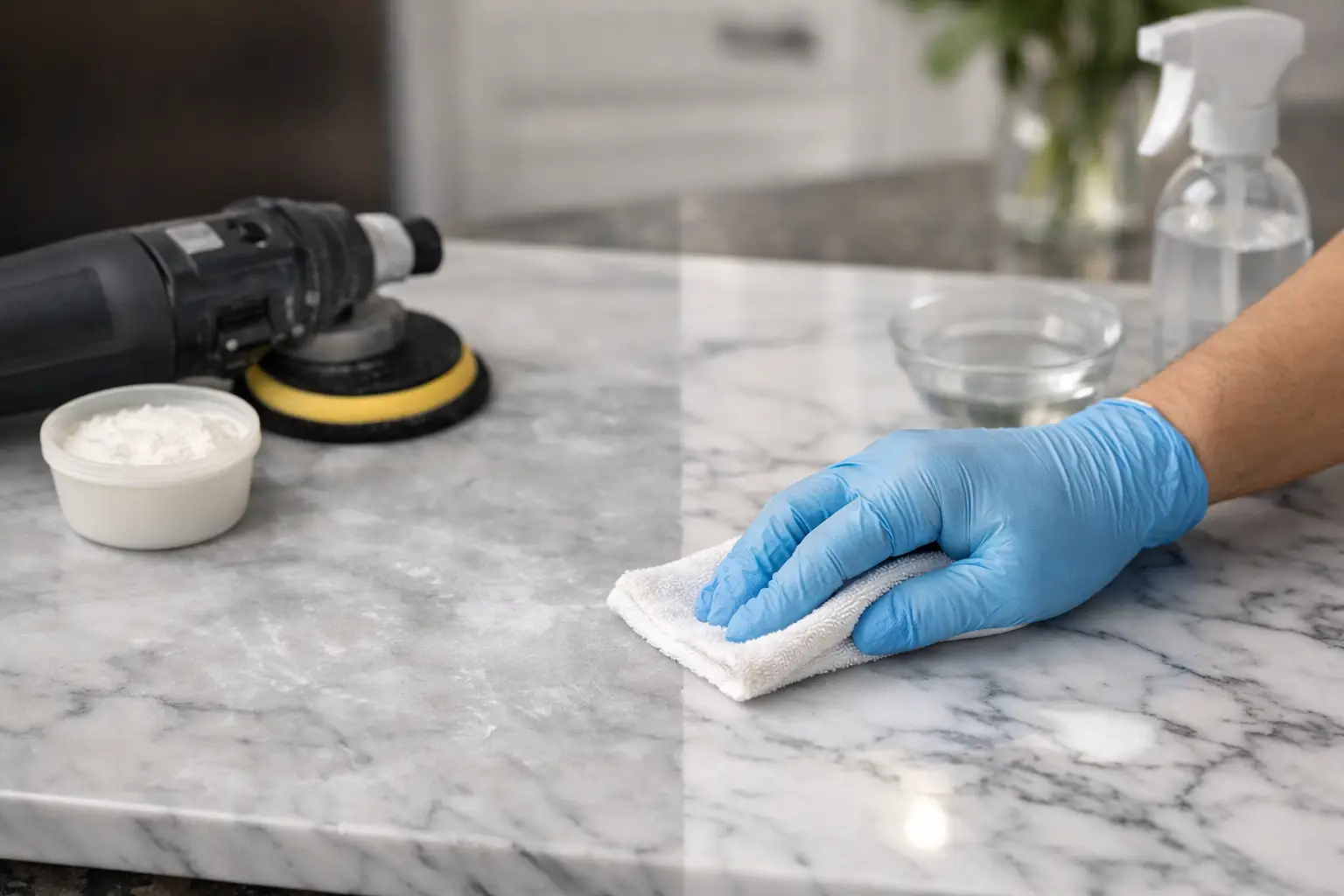
That cloudy ring beside the basin or dull patch on a marble benchtop is rarely a stain. More often, it is etching – a chemical reaction that has altered the stone’s surface and stripped away its clarity. If you are searching for how to restore etched marble, the first step is understanding that marble has not simply become dirty. Its finish has been physically changed.
Etching is one of the most common issues seen on premium stone surfaces, particularly in kitchens, bathrooms and commercial spaces where acidic products are used every day. Lemon juice, vinegar, wine, some bathroom cleaners and even certain hand soaps can leave marble looking flat, patchy and worn. The good news is that etched marble can usually be restored beautifully. The right method depends on how deep the damage goes, what finish the stone originally had, and whether the affected area is isolated or widespread.
What etching actually does to marble
Marble is a calcium-based natural stone. That composition gives it elegance, depth and a timeless look, but it also makes it vulnerable to acids. When an acidic substance contacts the surface, it reacts with the calcium carbonate and microscopically dissolves the top layer. What remains is a dull or lighter mark that catches light differently from the surrounding stone.
This is why etching is often mistaken for a spill mark that should wipe away. It will not. A cleaner may remove residue, but it cannot rebuild the polished surface that has been chemically disturbed. Restoring etched marble means refinishing the stone so the affected area blends back into the surrounding finish.
How to restore etched marble based on severity
The restoration process is not one-size-fits-all. A faint etch on a polished vanity top may respond to a marble polishing compound. A heavily etched floor, however, often needs honing and professional machine polishing to create an even finish again.
Light etching on polished marble
If the etch is very shallow and limited to a small area, a marble polishing powder or compound designed specifically for calcium-based stone may improve the finish. This works best on polished marble rather than honed marble, and only when the mark is minor.
The surface should be cleaned first with a pH-neutral stone cleaner and dried fully. The polishing product is then worked over the affected area with a soft white pad or polishing cloth according to the manufacturer’s directions. The goal is to refine the disrupted surface enough to bring back gloss.
This approach can be suitable for a small ring on a benchtop or vanity, but it has limits. If the etch is larger than a coin, visible from several angles, or surrounded by uneven shine, spot treatment can create a patch that still looks inconsistent.
Moderate etching and widespread dullness
When marble shows multiple etch marks or a broad area of dullness, the surface usually needs honing before polishing. Honing uses fine abrasives to remove a controlled amount of stone and level out the affected layer. After that, the stone can be polished back to the desired sheen.
This is where technique matters. Marble does not restore well through guesswork. Uneven pressure, the wrong abrasive sequence or over-polishing one section can leave swirl marks, lippage in appearance, or obvious differences in gloss. On larger surfaces such as floors, kitchen islands or hotel vanities, machine-based restoration is typically the only way to achieve a uniform result.
Deep etching, scratches and combined damage
Etching often appears alongside scratching, wear paths and ingrained dullness. In those cases, restoration is more than a polish. The stone may need a full refinishing process that includes honing through several grit levels, repair of minor chips if required, polishing or burnishing to the chosen finish, and sealing once the surface is properly restored.
For high-value marble, this is usually the most economical option compared with replacement. It preserves the existing stone, avoids disruption and restores the finish with far greater consistency than piecemeal DIY attempts.
Why DIY restoration sometimes works – and often falls short
There is a place for careful DIY treatment, but only within a narrow range. If you have one small, fresh etch mark on polished marble and the stone is otherwise in excellent condition, a quality marble polish may give a satisfactory improvement. Beyond that, the risks increase quickly.
Many over-the-counter products are marketed too broadly. Some are better suited to granite or engineered surfaces, while others add temporary shine without truly correcting the stone. Worse still, acidic cleaners, abrasive scrubbing pads and general-purpose polishing products can intensify the damage.
Marble is also unforgiving when it comes to matching finish. A professional restoration does not just remove the etch. It restores consistency across the surface so the repaired area does not stand out in daylight, downlights or angled reflection. That distinction matters in premium interiors, where even minor variations can make an expensive surface look tired.
The professional process for restoring etched marble
A specialist restoration begins with identifying the stone correctly and assessing the original finish. Polished Carrara, honed limestone-look marble, high-traffic foyer stone and a bathroom vanity all require different treatment decisions. The restoration method should suit the material, the setting and the client’s expectations for the final look.
Assessment and testing
The first stage is to determine whether the marks are true etching, staining, topical residue or a combination of issues. Test areas help confirm how the marble responds before broader restoration begins. This prevents over-treatment and allows the finish to be tailored.
Honing the affected surface
If the etching has changed the texture or reflectivity of the stone, honing is used to remove the damaged surface evenly. On floors and larger installations, this is done with professional equipment and a controlled abrasive sequence. The aim is a flat, uniform surface with no visible low points or isolated glossy patches.
Polishing to restore brilliance
Once the etching has been honed out, the marble can be polished to the desired level of shine. Some clients prefer a high-gloss finish that reflects light and enhances veining. Others choose a softer honed appearance that feels more contemporary and can make future etching less visually obvious.
There is no single correct finish. It depends on the stone, the space and how the surface is used.
Sealing and protection
After restoration, sealing helps reduce the absorption of liquids and staining agents. It is worth being clear here – sealer does not make marble acid-proof. It helps with penetration, not etching. If orange juice, vinegar or harsh bathroom products sit on marble, etching can still occur.
For surfaces exposed to regular acid contact, added protection may be worth considering. In some settings, protective films or specialised barrier systems can help preserve the finish of vulnerable marble tops while maintaining a premium appearance.
How to keep restored marble looking its best
Once etched marble has been professionally restored, maintenance becomes the difference between a short-lived result and a lasting one. Daily care should be simple and stone-safe. Use a pH-neutral cleaner, a soft microfibre cloth and prompt wipe-up of spills. Avoid bleach, vinegar, citrus cleaners and supermarket sprays that are not approved for natural stone.
In kitchens and bathrooms, habits matter as much as products. Soap bottles, toiletry containers and drink glasses can all leave marks if moisture or acidic residue sits beneath them. Trays, coasters and regular wipe-downs make a real difference. In commercial spaces, scheduled maintenance and periodic re-polishing help preserve presentation without waiting for the damage to become severe.
When it is time to call a marble restoration specialist
If the marble still looks dull after cleaning, if the etched areas are spreading, or if the finish appears uneven across the surface, it is usually time for expert assessment. The same applies where marble has sentimental, architectural or high replacement value. A premium stone surface deserves a treatment plan based on craftsmanship, not trial and error.
For many Sydney properties, especially those with luxury bathrooms, kitchens, foyers and reception areas, marble restoration offers a far smarter outcome than replacement. It protects the original material, restores elegance and extends the life of the surface with less disruption. That is exactly why specialist companies such as Grand Stone Restoration focus on restoration as a refined, cost-effective alternative to starting again.
Etched marble is frustrating because it can make an otherwise beautiful room feel worn before its time. Restored properly, though, marble regains the depth, light and sophistication that made it worth choosing in the first place.