
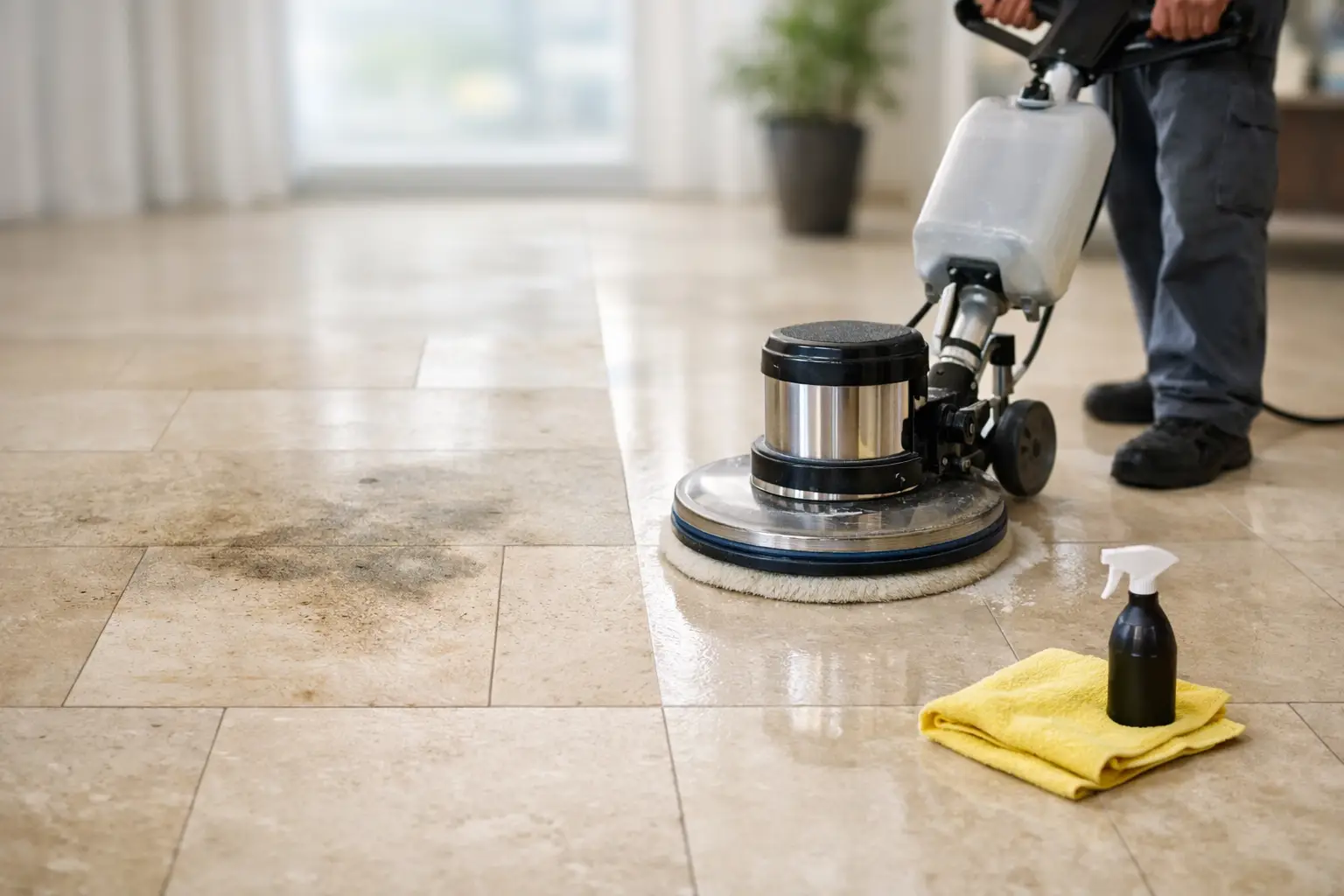
A dark ring under a planter, rust near a balcony door, oil tracked in from a kitchen – limestone rarely stains in dramatic fashion at first. It tends to absorb quietly, then hold the mark in a way that ordinary cleaning cannot shift. Effective limestone floor stain treatment starts with one fact: limestone is a calcium-based stone with natural porosity, so the wrong product can lock in damage or create a second problem while chasing the first.
Why limestone stains behave differently
Limestone is elegant, understated and highly sought after in premium interiors, but it is not a forgiving surface. Unlike harder and less reactive stones, limestone can absorb liquids beneath the surface while also reacting to acidic spills at the face. That distinction matters.
A true stain sits within the stone and discolours it. Etching is different – it is chemical damage that changes the finish itself, often leaving a dull or pale patch. Many property owners see a mark and assume it needs stronger cleaner, when what it really needs is the correct diagnosis. If an acidic product is used on limestone, the finish can become rougher, flatter and more visibly damaged even if the original spill is partly removed.
This is where treatment becomes material-specific. The best result is not simply lifting the mark. It is removing or reducing the discolouration while preserving the uniform, refined appearance of the floor.
Limestone floor stain treatment starts with identifying the stain
Not all stains respond to the same method, and limestone does not reward guesswork. Organic marks from food, coffee or plant matter behave differently to oil-based staining, rust, mould, grout haze or old cleaning residue.
Oil is one of the more common issues in kitchens and entry areas because it penetrates deeply and darkens the stone. Organic staining often leaves brown, yellow or greenish discolouration, particularly in damp zones or under pot plants. Rust is especially difficult because metal contamination can travel into the pores and create orange-brown spotting that is stubborn to remove. In bathrooms and commercial settings, soap build-up and cleaning product residue can also leave the floor looking stained when the issue is actually surface film and mineral accumulation.
For that reason, professional limestone floor stain treatment usually begins with testing. A specialist will assess whether the problem is topical, absorbed, reactive or a combination of all three. That assessment shapes everything that follows.
What should never be used on limestone
The biggest mistakes usually come from products that seem harmless because they are common household staples. Vinegar, lemon, bleach-heavy mixes and many bathroom sprays are all risky on limestone. So are harsh supermarket degreasers and abrasive scrubbing pads.
Acidic products can etch the stone almost immediately. Highly alkaline or solvent-heavy products can alter the finish, weaken sealers or create patchiness. Even steam cleaning can be a poor choice in some cases if the floor has existing weakness in the grout lines or if staining is being pushed deeper through heat and moisture.
There is a trade-off here. Fast DIY fixes can appear cheaper, but on natural stone they often turn a removable stain into a restoration issue. Once the surface has been chemically altered, treatment may require honing and refinishing rather than stain removal alone.
How professional treatment typically works
The right process depends on the stain type, the depth of penetration and the finish of the limestone. Honed limestone, filled limestone and textured formats all respond differently. A polished-looking finish also requires more control, because uneven treatment can leave visible variation across the floor.
Targeted stain removal
For localised staining, a specialist may use a poultice or treatment compound designed to draw contamination out of the pores. This is not a one-size-fits-all paste. The active ingredients need to match the stain, otherwise the result can be disappointing or inconsistent. Some stains lift in one application, while older or deeper marks may need several treatment cycles.
Deep cleaning and residue removal
Sometimes the floor is not truly stained in isolated areas – it is broadly discoloured by embedded soil, old sealers, detergent residue or moisture-related build-up. In these cases, controlled deep cleaning with stone-safe products is often the first step. The goal is to strip away contamination without opening the surface to further damage.
Honing to address etching and surface damage
If the mark is partly stain and partly etch, chemical treatment alone will not fully restore the appearance. The damaged layer may need to be honed back using the correct abrasives for limestone. This removes the affected surface evenly and brings back a clean, consistent finish.
Sealing for future protection
Once the floor is clean and restored, sealing helps reduce future absorption. It does not make limestone stain-proof, and that is a point worth being clear about. A quality sealer buys you time to clean spills before they penetrate, but it does not prevent etching from acids and it does not eliminate maintenance. The benefit is practical protection, not invincibility.
When stain treatment becomes full restoration
There are times when spot treatment is not enough. If the floor has traffic dullness, patchy sealing, widespread etching, old repairs or inconsistent colour, isolated stain removal can make the surrounding surface look more uneven. In premium homes and presentation-critical commercial spaces, that is rarely an acceptable outcome.
A more complete restoration may involve deep cleaning, stain treatment, honing, minor repairs and sealing as a combined process. This approach is often more cost-effective than repeated attempts to treat individual marks over time. It also delivers the finish most owners actually want – not just a stain reduced, but the floor returned to a more elegant, cohesive appearance.
For larger properties across Sydney, this matters even more. In foyers, retail spaces and high-end residences, limestone is part of the visual standard of the property. A patchy floor lowers that standard quickly.
How to reduce the risk of new staining
Good maintenance does not need to be complicated, but it does need to suit the stone. Use a pH-neutral cleaner made for natural stone. Clean spills promptly, especially oil, wine, coffee and anything acidic. Avoid letting wet mats, metal furniture feet or pot plants sit directly on the floor for extended periods.
It also helps to review how the space is used. Entry points may need better matting to reduce tracked-in grit and moisture. Kitchens may need more frequent gentle cleaning rather than occasional aggressive scrubbing. Outdoor-connected limestone may require different protection depending on exposure and drainage. The right maintenance plan is less about doing more and more about doing the correct things consistently.
Signs it is time to call a specialist
If a stain has been there for weeks, if the floor looks dull around the mark, or if previous cleaning has changed the texture or sheen, expert treatment is usually the safer path. The same applies if the limestone has multiple issues at once, such as staining, etching and scratches.
Natural stone rewards precision. A specialist restoration company understands how limestone differs from marble, travertine, terrazzo and engineered surfaces, and that difference affects product choice, abrasion level, dwell time and sealing strategy. Grand Stone Restoration approaches limestone with that material-specific care, because premium stone does not respond well to generic methods.
The strongest results come from treating the cause as well as the mark. That might mean removing rust sources, improving moisture control, changing maintenance products or resealing the floor after restoration. Without that step, even a well-executed treatment can become a temporary fix.
Limestone can absolutely recover from staining, but it responds best to measured, expert-led treatment rather than trial and error. If your floor has lost its clarity, the right restoration approach can do more than remove a mark – it can return depth, softness and quiet luxury to the entire room.