
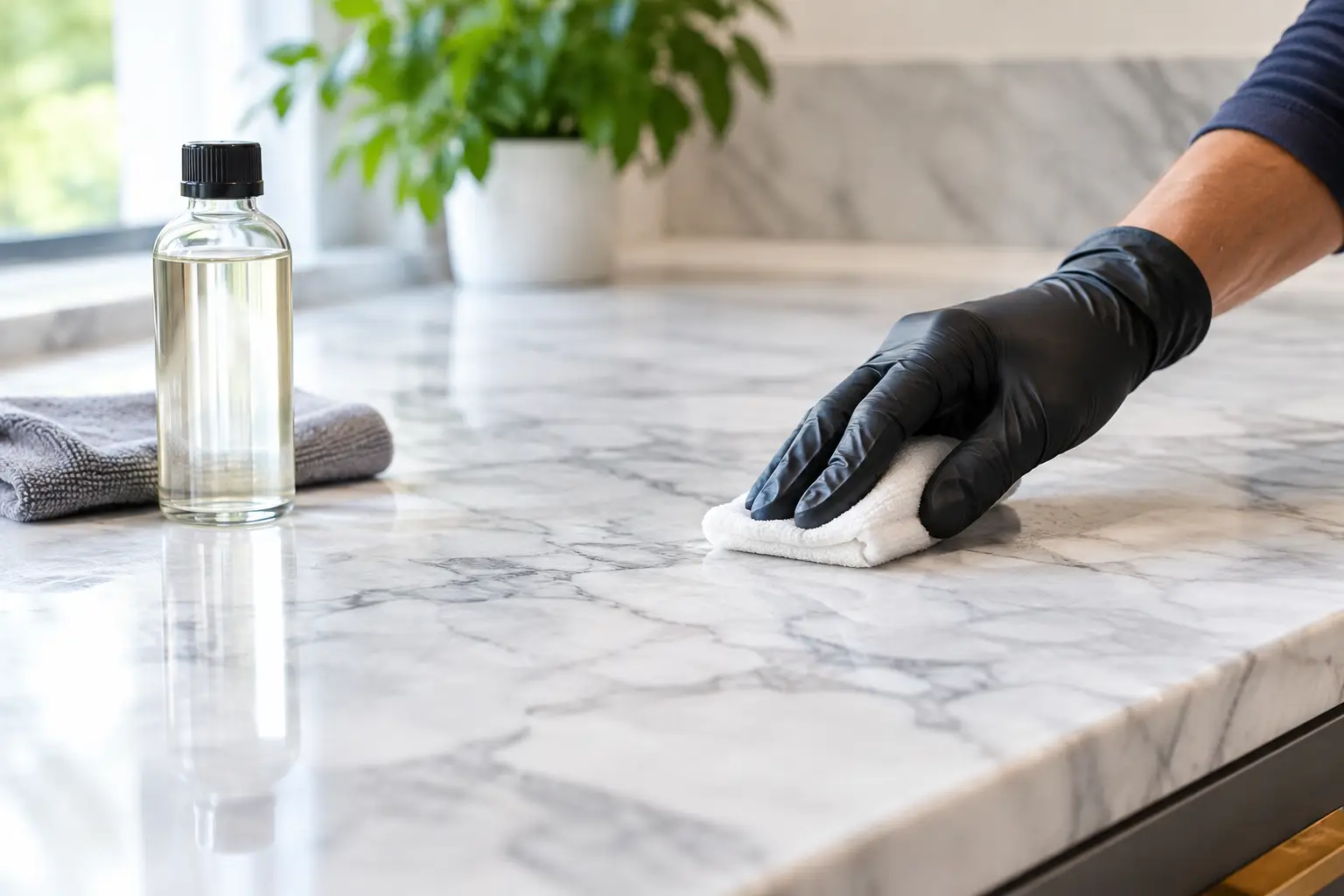
A marble surface can look immaculate after polishing, then lose its clarity far sooner than expected when the wrong sealer is applied. This marble sealer review cuts through the broad product claims to explain what a sealer genuinely does, where it falls short, and how to choose protection that respects the character of natural stone.
For Sydney homes and commercial interiors, the right approach is rarely about finding the shiniest bottle or the strongest-smelling formula. It is about matching the treatment to the marble’s finish, porosity, location and existing condition. A honed Carrara bathroom floor, polished Calacatta benchtop and high-traffic hotel foyer do not need the same protection.
What a Marble Sealer Is Designed to Do
Most quality marble sealers are penetrating impregnators. Rather than leaving a thick coating on top, they enter the microscopic pores of the stone and help resist the absorption of water, oil and coloured liquids. This gives you more time to wipe up spills before they become a stain.
That extra response time matters on kitchen benchtops, vanity tops, dining tables and floor tiles. Cooking oil, cosmetics, red wine, coffee and make-up can darken pale marble if left to penetrate. A well-chosen impregnating sealer limits this risk while preserving the stone’s natural appearance and breathability.
A sealer is not, however, a cure for every marble problem. It will not remove existing etching, restore a worn polish, conceal scratches or repair chips. It also cannot make marble immune to acidic substances. Lemon juice, vinegar, wine and many bathroom cleaners can react with the calcium in marble, leaving a dull or pale etch mark even when the surface has been sealed.
This distinction is where many product reviews become misleading. Stain resistance and etch resistance are different forms of protection. Marble needs the former as standard; the latter often requires a more specialised solution.
Marble Sealer Review: Penetrating Versus Topical Products
The strongest choice for most interior marble is a premium penetrating sealer formulated for natural stone. It protects below the surface without creating an artificial sheen or changing the colour dramatically. On polished marble, this is particularly important. The surface should retain its refined depth and brilliance, not look lacquered or plastic-like.
Topical sealers sit on the surface and form a film. They can be useful in select applications, but they are not a universal answer for marble. A film-forming product may initially make the stone appear glossier or darker, yet it can wear unevenly under foot traffic, scratch, peel or trap moisture. On a fine polished floor or luxury benchtop, that failure can be more noticeable than the original issue.
Colour-enhancing sealers are another category requiring care. They are often suitable for certain honed, tumbled or textured stones where a deeper tone is desired. On light polished marble, an enhancer can produce an unwanted patchy or permanently darkened appearance. Always assess a discreet test area before committing to treatment across the entire surface.
The best product is therefore not necessarily the product with the boldest promise. It is the one that suits the exact stone and produces an even, natural result.
What to Look For in a Quality Sealer
A worthwhile marble sealer should be easy to apply evenly, resist common household staining agents and cure without leaving a visible residue. It should also be suitable for the intended setting. Benchtops and dining surfaces need a treatment appropriate for areas that may come into contact with food, while wet areas need reliable water resistance without compromising grip or appearance.
Low-odour, low-VOC formulations are often preferable indoors, particularly in occupied homes, apartment buildings and hospitality environments. Yet low odour alone does not determine performance. The key consideration is the sealer’s compatibility with the stone, finish and use of the space.
Coverage claims also deserve a practical reading. A dense polished marble may require less product than a porous honed marble, but grout lines, worn sections and repaired areas can absorb more than expected. Uneven absorption is one reason professional preparation and application deliver a more consistent finish than a quick DIY coat.
The Most Common Mistake: Sealing Damaged Marble
Sealer should be the final protective stage, not the first response to dull or marked stone. Applying it over etching, ingrained grime, soap residue or old coatings can lock in the problem and reduce the clarity of the finish. The marble may be protected, but it will not look restored.
Professional restoration typically begins by identifying the damage. Light etching may need polishing; deeper wear may require honing to level the surface before progressively refining the finish. Chips and cracks should be repaired with colour-matched materials, while stubborn stains may require targeted treatment before sealing.
Once the marble is clean, dry and properly restored, the sealer can bond and perform as intended. This sequence protects the investment in the surface rather than simply masking deterioration.
How Often Should Marble Be Sealed?
There is no responsible one-size-fits-all schedule. Some dense polished marbles in low-use areas may hold protection for years, while a honed kitchen island or busy commercial vanity may need more frequent attention. Heavy cleaning, abrasive products, steam exposure and continual moisture can shorten a sealer’s effective life.
The simplest indication is a controlled water test. Place a few drops of water on a clean, dry area and observe them for several minutes. If the water beads and does not darken the marble, the protective treatment is likely still active. If it absorbs and leaves a darkened spot, resealing may be needed.
This test does not measure acid resistance, and it should not be performed with lemon juice or vinegar. Acid tests can etch marble and create damage that was not there beforehand.
When a Sealer Is Not Enough
For marble benchtops exposed to regular cooking, entertaining or young families, a penetrating sealer provides essential stain protection but cannot eliminate the risk of etching. Owners who want more comprehensive protection may benefit from anti-etch film. This clear protective layer is designed to reduce the impact of acidic spills and daily wear while retaining the visual elegance of the stone.
It is a considered option, not an automatic upgrade. Anti-etch film changes the maintenance equation and can be highly valuable in high-use areas, but its suitability depends on the stone profile, edge detail, existing condition and desired finish. In formal spaces with lower exposure, expert sealing and careful cleaning may be entirely appropriate.
Likewise, outdoor marble has its own demands. Pool surrounds, balconies and entry areas must contend with UV exposure, rain, moisture movement and foot traffic. The wrong coating can become slippery, discolour or break down prematurely. Exterior protection needs to be selected for both the stone and the environment.
Application Quality Matters as Much as the Product
Even premium sealers can disappoint when applied over damp stone, unevenly spread, allowed to dry on the surface or layered without need. Excess product can leave hazing, streaks or tackiness, particularly on polished finishes. Removing cured residue can require specialist correction.
For small, sound surfaces, careful DIY application may be reasonable when the product is clearly suited to marble and the instructions are followed exactly. For valuable benchtops, extensive flooring, heritage stone or surfaces with visible wear, specialist assessment is the safer investment. The right service considers restoration, sealing and ongoing care as one process, rather than treating a sealer as a standalone fix.
Grand Stone Restoration approaches marble protection with that level of precision, selecting treatments around the stone’s condition and the way the space is actually used.
Care That Preserves the Finish After Sealing
Sealed marble still benefits from prompt spill removal and pH-neutral stone cleaning. Avoid acidic cleaners, abrasive powders, bleach-heavy products and general-purpose sprays that may dull the finish over time. Use soft cloths or non-abrasive pads, and place coasters beneath drinks and protective mats beneath toiletries or oil-prone kitchen items.
The finest result comes from treating marble as the natural, luxurious material it is: restore it properly, seal it for its real-world use, and maintain it with the same care that gave the surface its original brilliance.