
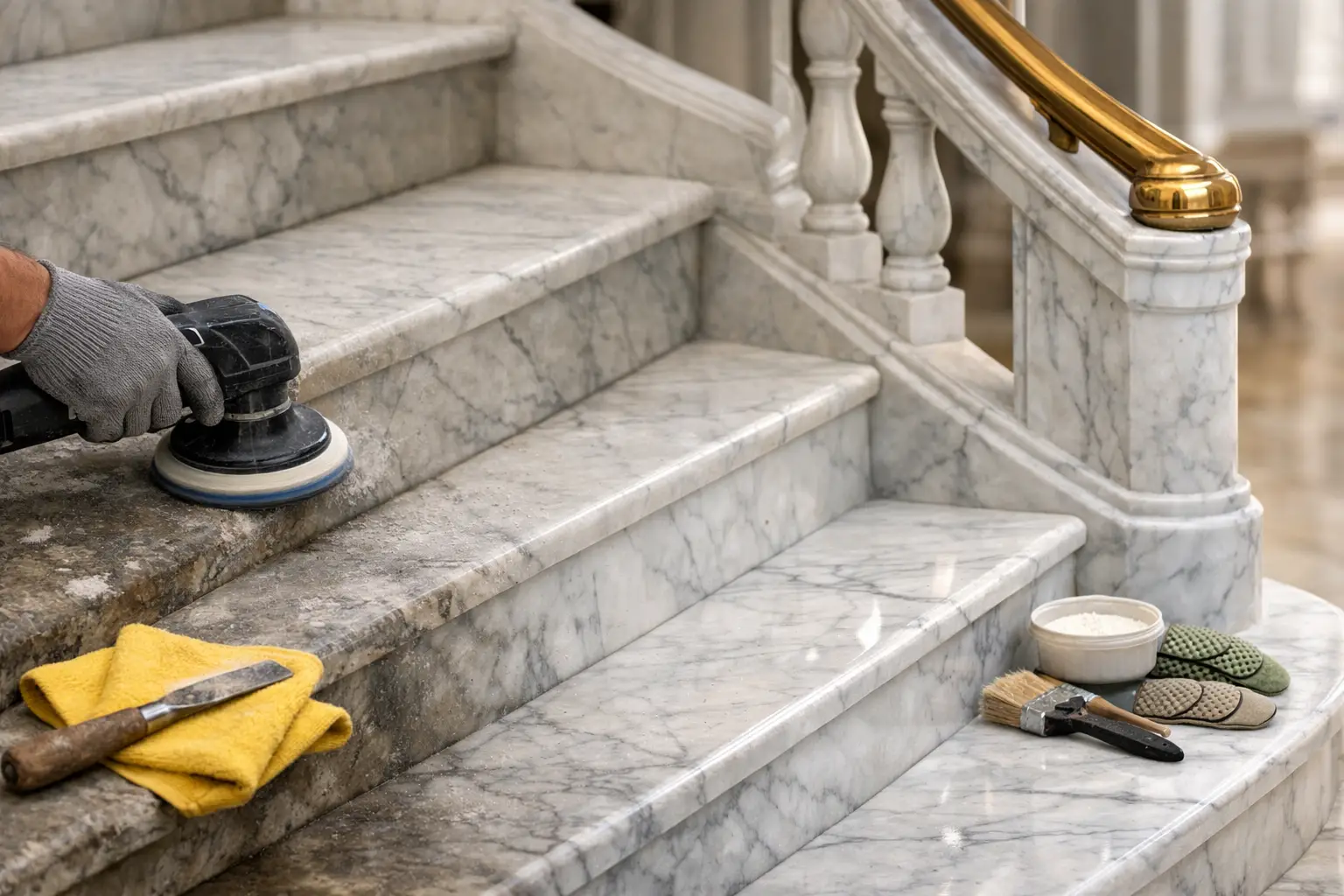
A marble staircase should create an immediate impression of quality. When the treads are dulled by foot traffic, scarred by grit, etched by spills or chipped along exposed edges, that impression changes quickly. Professional marble staircase restoration returns depth, clarity and consistency to the stone while preserving the original material that gives the space its character.
For Sydney homes, apartment buildings, hotel entries and commercial foyers, restoration is often a more considered alternative to replacing marble. Existing stone can be repaired, honed, polished and protected with far less demolition, downtime and expense than a complete rebuild. The right treatment, however, depends on the marble’s condition, finish and location.
Why marble stairs lose their finish
Marble is dense and durable, but it is not indestructible. Staircases receive concentrated wear in the same places every day: the leading edge of each tread, the central walking line, landings and areas near entry doors. Fine sand and debris carried in on shoes act like abrasive particles underfoot, gradually creating a worn, greyed appearance.
Acidic substances are another common source of damage. Marble contains calcium carbonate, which reacts to acidic cleaners, drinks and other spills. This reaction creates etching – pale, dull marks where the surface has been chemically altered. Etching is often mistaken for staining, but ordinary cleaning will not remove it because the damage is in the stone’s finish rather than sitting on top of it.
Scratches, small chips, open joints and uneven gloss can make a staircase appear older than it is. In shared buildings, previous spot repairs may also leave noticeably different colours or levels of shine from one tread to the next. A successful restoration addresses the entire visual field, not just the most obvious blemish.
What marble staircase restoration involves
A premium result begins with an accurate assessment. Marble varies significantly in hardness, veining, porosity and colour, so the process should never be treated as a one-size-fits-all cleaning job. A specialist examines the surface for scratches, etching, staining, cracks, loose pieces, failed grout or adhesive, lipping between tiles, and wear patterns that may continue after the work is complete.
Cleaning and contaminant removal
Before refinishing can begin, the stone must be properly cleaned. This is more than a quick mop or generic chemical wash. Dirt, old coatings, soap residue and unsuitable cleaning products can mask the real condition of the marble and interfere with subsequent treatment.
The cleaning method needs to be pH-appropriate for natural stone. Harsh acidic or highly alkaline products can worsen existing damage, particularly around stair nosings and edges where marble is already vulnerable. Careful preparation allows the true colour and structure of the stone to emerge.
Repairing chips, cracks and damaged edges
Chipped stair nosings are particularly noticeable because they interrupt the clean line of the staircase. Depending on the size, location and type of marble, chips can be rebuilt using colour-matched repair materials and shaped to follow the original profile. Fine cracks may also be stabilised and filled where appropriate.
Not every repair disappears completely at close range, especially in heavily veined marble or where a substantial piece is missing. The goal is a structurally sound, visually refined repair that blends naturally into the surrounding stone. An experienced technician balances colour, translucency and surface finish rather than applying a generic filler and hoping it matches.
Honing away etching and scratches
Honing is the controlled use of diamond abrasives to remove a fine layer of damaged stone. It is commonly the key step in correcting etching, traffic lanes, superficial scratches and uneven wear. By working progressively through suitable abrasive grades, the surface can be levelled and refined without unnecessary material removal.
This is where judgement matters. Marble stairs do not always need to be taken to a high polish. In a busy foyer, a honed finish may be the more practical choice because it offers a soft, elegant appearance while making future wear less conspicuous. In a formal residential entrance or luxury interior, a higher polish may be desired to restore the marble’s reflective brilliance.
Polishing for depth and consistency
Polishing refines honed marble to the selected sheen. It brings out the movement in the veining and creates a consistent finish across treads, risers and landings. The objective is not simply to make the surface shiny. It is to produce even clarity and reflectivity, without cloudy patches, swirl marks or abrupt changes between repaired and untouched areas.
A highly polished staircase can look exceptional, but it must suit the setting. Surface sheen, footwear, moisture exposure and building use all affect slip risk. In some environments, a lower-sheen finish or additional safety measures may be a better decision than pursuing maximum gloss.
Sealing and long-term protection
After restoration, an impregnating sealer can help reduce the stone’s absorption of water-based and oil-based contaminants. Sealing does not make marble stain-proof, scratch-proof or immune to etching. It provides valuable reaction time for spills to be removed before they penetrate the stone.
For staircases near entrances, protection should be paired with practical prevention. Quality entry mats, regular dry dusting and prompt attention to spills do more to preserve a restored surface than relying on sealer alone. In high-use commercial spaces, the maintenance plan should be as deliberate as the restoration itself.
When restoration is the smarter choice than replacement
Replacing a marble staircase involves more than purchasing new stone. It can require demolition, disposal, substrate preparation, matching adjacent finishes, new installation work and extended access restrictions. In apartment buildings and commercial properties, the disruption can affect residents, staff and visitors for days or longer.
Restoration retains the original marble and its established relationship with nearby floors, wall cladding and skirting. This is especially valuable where the stone is older, imported or difficult to match. It also avoids the uncertainty of sourcing new slabs with comparable veining and colour.
There are limits. Marble with widespread structural cracking, significant movement in the substrate, severely fractured tiles or persistent moisture issues may need more than surface restoration. A careful inspection should identify whether repairs will deliver a lasting result or whether selective replacement is necessary before refinishing.
Planning restoration in occupied properties
Staircases are circulation areas, so access planning is central to the quality of the job. In a private home, work can often be staged to keep an alternative route available. In strata buildings, offices, retail settings and hospitality venues, restoration may need to be scheduled around quieter periods or completed in sections.
Dust control, protection of adjoining surfaces and clear curing times all matter. A staircase should not be returned to foot traffic until the finish and any sealing treatment are ready for use. Rushing this stage can compromise the result and create avoidable safety issues.
For presentation-critical Sydney properties, Grand Stone Restoration approaches marble stairs as an architectural surface rather than a cleaning task. The treatment is tailored to the marble, the degree of damage and the finish expected in the space.
Caring for a restored marble staircase
The daily routine does not need to be complicated, but it does need to be suitable for marble. Dry dusting or vacuuming with a soft attachment removes abrasive grit before it is walked into the surface. For damp cleaning, use a clean microfibre mop and a stone-safe, pH-neutral cleaner, then avoid leaving excess water on treads or landings.
Avoid vinegar, citrus-based cleaners, bleach-heavy products and abrasive powders. These products can strip sealer, dull the finish or create fresh etching. Furniture and heavy items should be moved carefully, particularly across landings, and entry matting should be kept clean so it captures grit rather than redistributing it.
Periodic professional maintenance can be worthwhile in high-traffic buildings. Light re-honing or polishing at the right time is generally more efficient than waiting until wear becomes deep and widespread.
A marble staircase does not need to remain defined by dull traffic lanes, etched patches or damaged edges. With skilled assessment and considered restoration, it can once again carry the quiet confidence, elegance and lasting shine that made marble the right choice in the first place.