
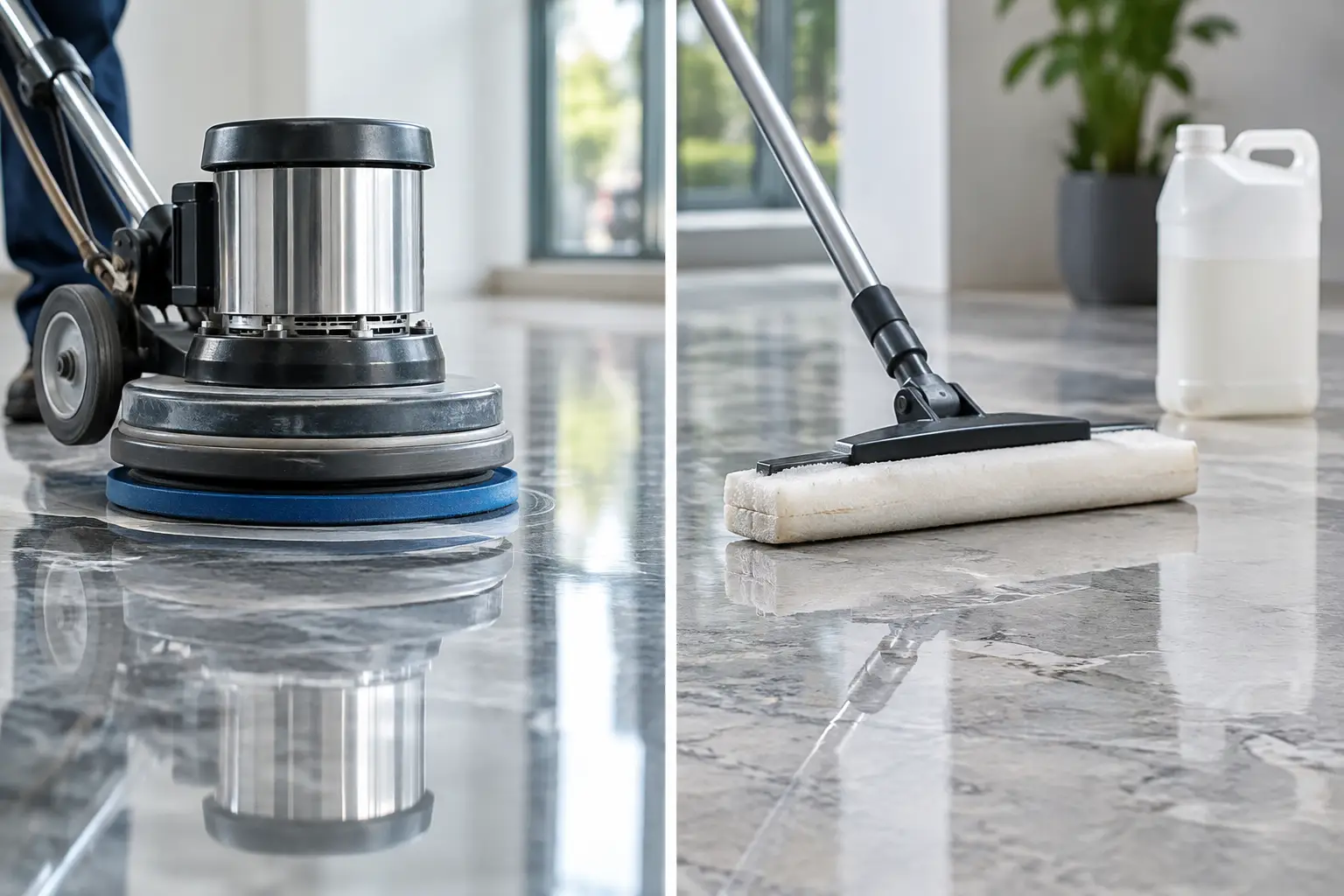
A marble foyer can look dull long before it is worn out. Fine scratching, acid etching, traffic lanes and uneven shine gradually take the elegance from an otherwise valuable surface. The choice between diamond polishing versus crystallisation determines whether that floor receives genuine surface restoration or simply a renewed cosmetic gloss.
Both methods can improve the appearance of suitable natural stone, particularly marble. They are not, however, interchangeable. The right treatment depends on the stone itself, the depth of damage, the desired finish and how the area is used. For premium residential interiors and presentation-critical commercial spaces, that distinction matters.
Diamond Polishing Versus Crystallisation: The Essential Difference
Diamond polishing is a mechanical restoration process. A specialist uses progressively finer diamond abrasives, typically with water, to refine the stone surface. Depending on its condition, the process may begin with grinding or honing to remove lippage, scratches, etching and dull patches before building the finish through finer polishing stages.
Crystallisation is a chemical-mechanical process used mainly on calcite-based stones such as marble, travertine and limestone. A crystallising compound is worked into the surface with a weighted machine and appropriate pad or steel wool. The reaction hardens and brightens the uppermost layer of the stone, creating a glossy appearance.
Put simply, diamond polishing corrects the stone by refining its surface. Crystallisation enhances the surface sheen but does not remove meaningful physical damage. A floor with deep etching or uneven wear will not become level or properly clear merely because it has been crystallised.
When Diamond Polishing Is the Better Investment
Diamond polishing is generally the stronger choice when marble has lost its original clarity and refinement. It is particularly effective for floors marked by light to moderate scratches, water rings, dull traffic paths, mild stains that have been treated, and the familiar cloudy patches caused by acidic spills.
Etching is often mistaken for staining. Lemon juice, wine, bathroom cleaners and some cleaning products can react with calcium-rich stone, leaving a pale, roughened or dull mark. The damage is within the surface itself, so it needs to be honed and polished away. A topical shine may disguise it briefly under certain light, but it will not restore the smooth, even reflection associated with a properly polished marble floor.
Mechanical polishing also gives the technician control over the final finish. Not every stone should be brought to a mirror gloss. Honed marble can suit a contemporary bathroom, while a polished limestone entrance may require a softer, more restrained lustre. The finish should be tailored to the stone, the light in the room and the level of foot traffic.
For older Sydney apartments, hotel lobbies and high-end homes, diamond restoration can also address unevenness between tiles. Where edges sit slightly higher than adjoining tiles, a process known as lippage removal can create a flatter, more sophisticated floor plane. This is detailed work, but it transforms the way a large stone floor reflects light.
Where Crystallisation Can Be Appropriate
Crystallisation has a place when it is selected for the right stone and used with restraint. On a dense marble floor that is already reasonably flat, clean and free from significant scratches, it can produce a pleasing high gloss. It is often considered for maintained commercial floors where appearance needs regular attention and downtime must be controlled.
The benefit is speed. Compared with a full multi-stage diamond restoration, crystallisation may refresh an acceptable surface with less intensive correction. If the marble is in sound condition and the goal is to lift the shine between more substantial restoration cycles, it can be a practical maintenance option.
That said, crystallisation should never be treated as a universal polishing solution. Results vary according to the stone’s composition, porosity, previous treatments and the product used. Overuse or poor application can lead to an unnatural-looking surface, inconsistent gloss, residue buildup or visible swirl patterns. On a premium floor, a quick shine is not a substitute for craftsmanship.
The Risks of Choosing Shine Over Restoration
The biggest issue with crystallisation is not that it always produces poor results. It is that it can be used to conceal problems that require a different remedy. A crystallised floor may look brighter immediately after treatment, yet still carry etched patches, worn pathways and scratches beneath that sheen.
Repeated chemical treatments can also complicate later restoration. A specialist may need to remove accumulated residues or inconsistent surface layers before achieving an even result with diamonds. This adds time and can make a simple-looking restoration more involved.
Slip resistance needs careful consideration as well. A highly reflective finish may be desirable in a lobby or formal entrance, but bathrooms, pool-adjacent spaces and commercial circulation areas have different performance requirements. The correct finish balances visual impact with practical safety, cleaning routines and the building’s use.
For these reasons, the surface should be assessed before any method is selected. A proper inspection identifies the stone type, existing coatings, structural cracks, hollow tiles, grout condition and the real cause of dullness. Stone restoration is material-specific work, not a one-product process.
Stone Type Changes the Answer
Marble is the material most commonly associated with both diamond polishing and crystallisation, but even within marble there are differences in density, veining and finish response. Travertine and limestone are softer, more porous calcite stones that require careful handling. They can often be honed and polished beautifully, though crystallisation must be approached conservatively and with suitable products.
Granite is a different proposition. It is a harder silicate stone, and diamond polishing is generally the appropriate method for restoring its finish. Crystallisation chemistry designed for marble does not deliver the same result on granite and should not be used as a generic solution.
Engineered stone, including quartz-based benchtops, is different again. These surfaces contain resins as well as mineral content, and aggressive abrasives or unsuitable chemicals can permanently alter their appearance. A dull Caesarstone or Silestone benchtop should be assessed according to the manufacturer’s guidance and its specific damage, rather than treated like natural marble.
The same caution applies to terrazzo, sandstone, porcelain tiles and concrete. Each surface has its own restoration pathway. The most convincing finish comes from respecting the material, not forcing every surface into the same high-gloss look.
A Better Decision Framework for Marble Floors
If the floor is visibly etched, scratched, uneven or patchy, diamond honing and polishing will usually provide the more durable and refined outcome. It restores the actual stone surface, producing a consistent finish rather than covering over damage.
If the floor is already in good condition but needs a controlled gloss refresh, crystallisation may be considered as part of a planned maintenance program. It should be performed by a stone specialist who understands the chemistry, tests a discreet area and can recognise when the surface needs mechanical correction instead.
For highly valuable stone, request an assessment based on the condition of the entire area rather than the appearance of one small patch. A sample section can be useful, especially where a client is deciding between a honed and polished finish. It reveals how the stone will respond and ensures the selected sheen suits the space before work begins.
Protecting the Result After Restoration
Neither diamond polishing nor crystallisation removes the need for sensible stone care. Use pH-neutral cleaners, wipe acidic spills promptly and avoid abrasive powders or generic bathroom products on calcium-based stone. Entry mats in foyers reduce grit, which is one of the main causes of fine scratching on polished floors.
Sealing can provide valuable stain resistance on porous stone, although it does not prevent acid etching or eliminate maintenance. In areas prone to etching, such as marble benchtops and vanity tops, protective surface films may offer an additional layer of defence while preserving the visual character of the stone.
A beautifully restored floor should look like stone at its best: clear, even, tactile and naturally elegant. Grand Stone Restoration assesses the material and damage first, then applies the restoration method that gives the surface its strongest long-term result – not simply its fastest shine.