
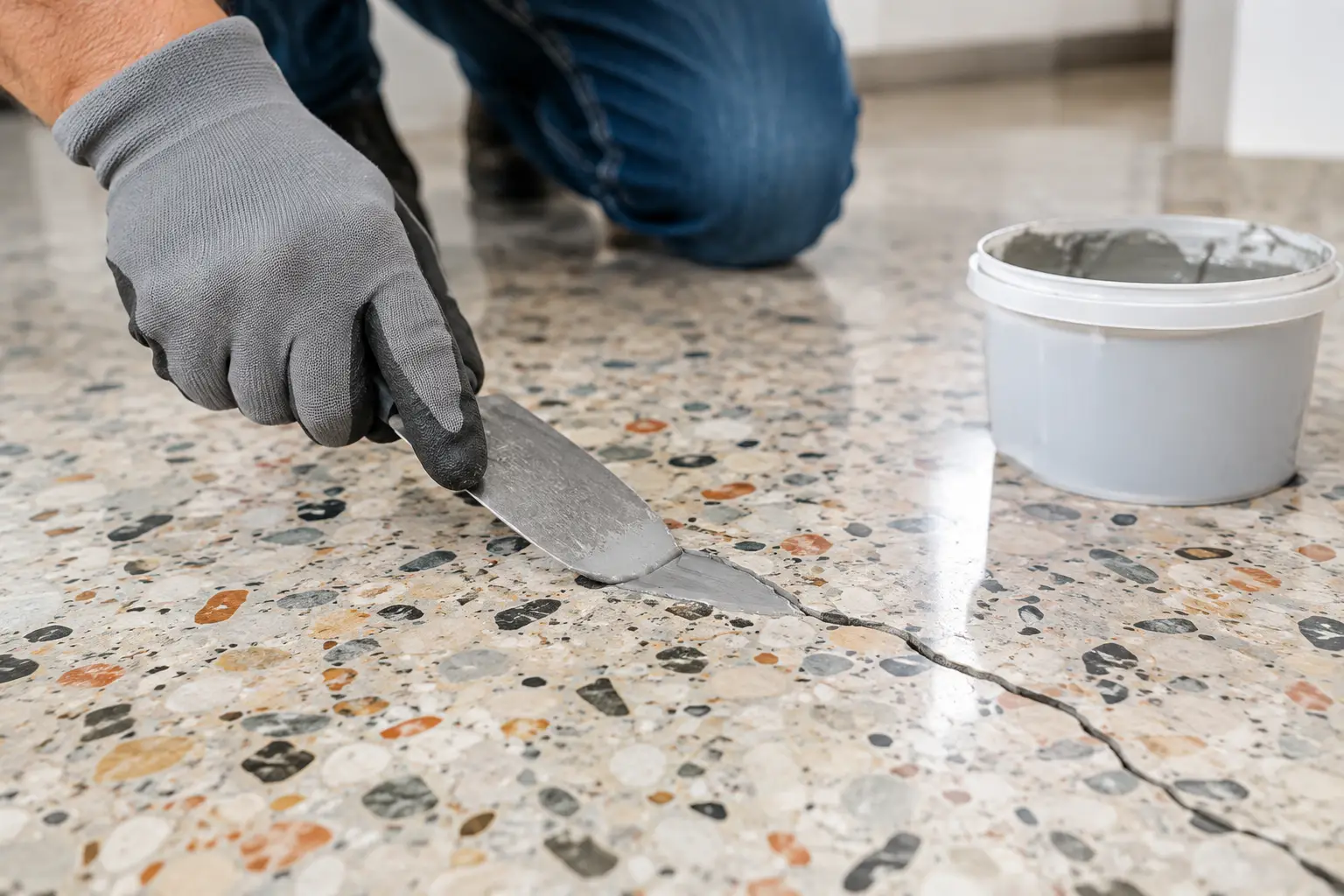
A crack across a terrazzo floor can pull attention from an otherwise elegant entrance, hallway or commercial foyer. To repair terrazzo floor cracks properly, the repair must do more than fill a gap. It needs to stabilise the damaged area, blend with the original matrix and aggregate, then be honed and polished so the floor reads as one refined surface again.
Terrazzo is exceptionally durable, but it is not immune to movement in the substrate, impact damage, building settlement or years of traffic. A well-executed restoration is often far more economical and considerably less disruptive than removing and replacing the floor. The result, however, depends on correctly identifying the cause and treating the material with the precision it deserves.
When to Repair Terrazzo Floor Cracks
Not every line in a terrazzo floor is a structural crack. Terrazzo naturally contains aggregate, decorative dividing strips and variations in colour that can be mistaken for damage. A genuine crack usually has a continuous, irregular line through the cement or resin matrix, sometimes with a slight opening, uneven edge or accumulated dirt.
Fine hairline cracks may be largely cosmetic, but they should not be ignored. Moisture, cleaning chemicals and grime can enter even a narrow opening, making it more visible over time and weakening the bond at the edges. In high-traffic areas, small cracks are also more likely to chip or spread.
Wider cracks, loose sections, hollow-sounding areas or cracks with noticeable height difference require specialist assessment. These signs can point to movement beneath the terrazzo rather than surface damage alone. Filling the visible line without addressing an unstable substrate may produce a short-lived result.
In Sydney apartments and commercial buildings, floor movement can occur around slab joints, doorways, service penetrations and areas affected by previous water ingress. The correct repair approach depends on whether the terrazzo is traditional cement-based terrazzo, epoxy terrazzo or a terrazzo-look tile. Each material responds differently to fillers, grinding and polishing.
Why DIY Crack Fillers Rarely Deliver a Premium Finish
A hardware-store epoxy can appear convenient, particularly for a small crack. The difficulty is not simply getting material into the opening. It is achieving the right colour, translucency, texture and level once the product cures.
Traditional terrazzo combines a binder with chips of marble, quartz, granite or glass. A flat, solid-coloured filler may close the crack but leave a conspicuous line through the floor. Some products also cure harder or softer than the surrounding terrazzo, causing uneven wear after cleaning and foot traffic. Others yellow, shrink or lose adhesion when exposed to moisture and temperature changes.
There is also a polishing issue. Terrazzo develops its characteristic lustre through a controlled honing and polishing sequence. Smearing filler across the surrounding surface, using an aggressive abrasive or applying a topical shine product can create a dull patch, swirl marks or an obvious repair halo. For a premium residence, lobby or retail environment, these compromises are difficult to overlook.
How Professionals Repair Terrazzo Floor Cracks
Professional terrazzo crack repair is a material-matching process, not a one-size-fits-all patch. The exact treatment varies with the floor’s composition, age, finish and condition, but quality restoration follows a disciplined sequence.
Assessing the crack and surrounding floor
The first stage is inspection. A restoration specialist checks whether the crack is stable, whether sections are loose, and whether staining or moisture is present. They also examine the terrazzo aggregate, binder colour, existing sheen and any previous coatings or unsuccessful repairs.
This assessment determines whether a flexible joint treatment, resin repair, cementitious repair or more extensive substrate work is appropriate. If movement is active, the repair may need to accommodate that movement rather than lock it rigidly in place.
Preparing a clean, sound repair channel
The crack is carefully cleaned and prepared to remove loose material, old filler, embedded soil and weak edges. Depending on its nature, the crack may be opened slightly to create a sound channel for the repair compound. This is controlled work: removing too little can leave a weak bond, while removing too much can make the repair unnecessarily visible.
The area must be dry and free of contaminants. Oil, wax, residual sealer and moisture can interfere with adhesion, particularly in older floors that have received repeated maintenance treatments.
Matching the terrazzo matrix and aggregate
This is where craftsmanship makes the visible difference. The repair material is tinted to work with the surrounding binder, then selected aggregate is incorporated where required. Matching may involve marble chips or other decorative fragments chosen for their size, colour and distribution.
A repair does not always become completely invisible, especially on heavily patterned or aged terrazzo. The goal is a cohesive finish that does not interrupt the visual flow of the floor. In many cases, a properly colour-matched repair becomes difficult to notice at normal standing height after honing and polishing.
Filling, curing and refining the surface
The repair compound is worked into the prepared crack to eliminate voids and ensure solid contact with the edges. Once cured, the repaired area is ground or honed flush with the surrounding terrazzo. This step requires care to avoid creating a low spot or cutting the adjacent floor unevenly.
Where several cracks, chips or worn areas are present, local repairs may be followed by restoration of the broader section or entire room. This creates a more consistent level of clarity and sheen, rather than leaving a newly polished strip beside a tired, dull floor.
Honing, polishing and protecting the finish
After the repair is level, the terrazzo is refined through suitable abrasives to restore its smoothness and reflectivity. The desired finish can range from a soft honed appearance to a high-polish finish with greater light reflection. The right choice depends on the space, the original floor and practical considerations such as slip resistance and maintenance expectations.
A penetrating sealer may then be applied where appropriate to improve resistance to staining and simplify routine care. Sealing is protective, but it is not a substitute for structural repair, and it will not stop a moving crack from returning. Good maintenance and prompt attention to spills remain part of protecting the finish.
Should You Repair One Crack or Restore the Entire Floor?
For an isolated, stable crack in an otherwise glossy and well-maintained floor, a targeted repair may be all that is needed. This is often a sensible option where the affected area is small and the existing surface finish can be blended successfully.
A wider restoration is worth considering when the floor has multiple cracks, dull traffic paths, etching, deep scratches, old coatings or inconsistent sheen. Restoring the full area allows repairs to disappear more naturally into a uniform finish. It can also be the more cost-effective choice when repeated spot repairs would leave the floor looking pieced together.
Commercial properties have another consideration: presentation. A repaired terrazzo foyer should support the standard of the building, not signal deferred maintenance. Scheduling works outside peak trading or office hours can reduce disruption while bringing the entrance back to a finish that reflects the quality of the property.
Care After a Terrazzo Crack Repair
Avoid heavy use until the repair has cured as advised. After that, use pH-neutral stone cleaners and clean microfiber mops rather than acidic bathroom products, bleach or abrasive powders. Acidic products can etch cement-based terrazzo and dull the surrounding finish, while harsh scrubbing may prematurely wear protective treatments.
Place quality mats at external entrances to reduce grit, especially in busy foyers. Grit acts like sandpaper under shoes and can gradually reduce polish in high-traffic lanes. Furniture should be fitted with clean protective pads, and spills should be attended to promptly rather than left to penetrate the surface.
If a crack reopens, develops a height difference or is accompanied by tile-like movement, arrange an assessment rather than applying another layer of filler. Grand Stone Restoration can evaluate the floor’s condition and recommend a tailored repair and polishing approach that respects both the material and the standard of the space.
A terrazzo floor carries a sense of permanence when it is cared for properly. Addressing cracks early, with a repair matched to the original surface, preserves that character and gives the floor every chance to retain its elegance for years to come.