
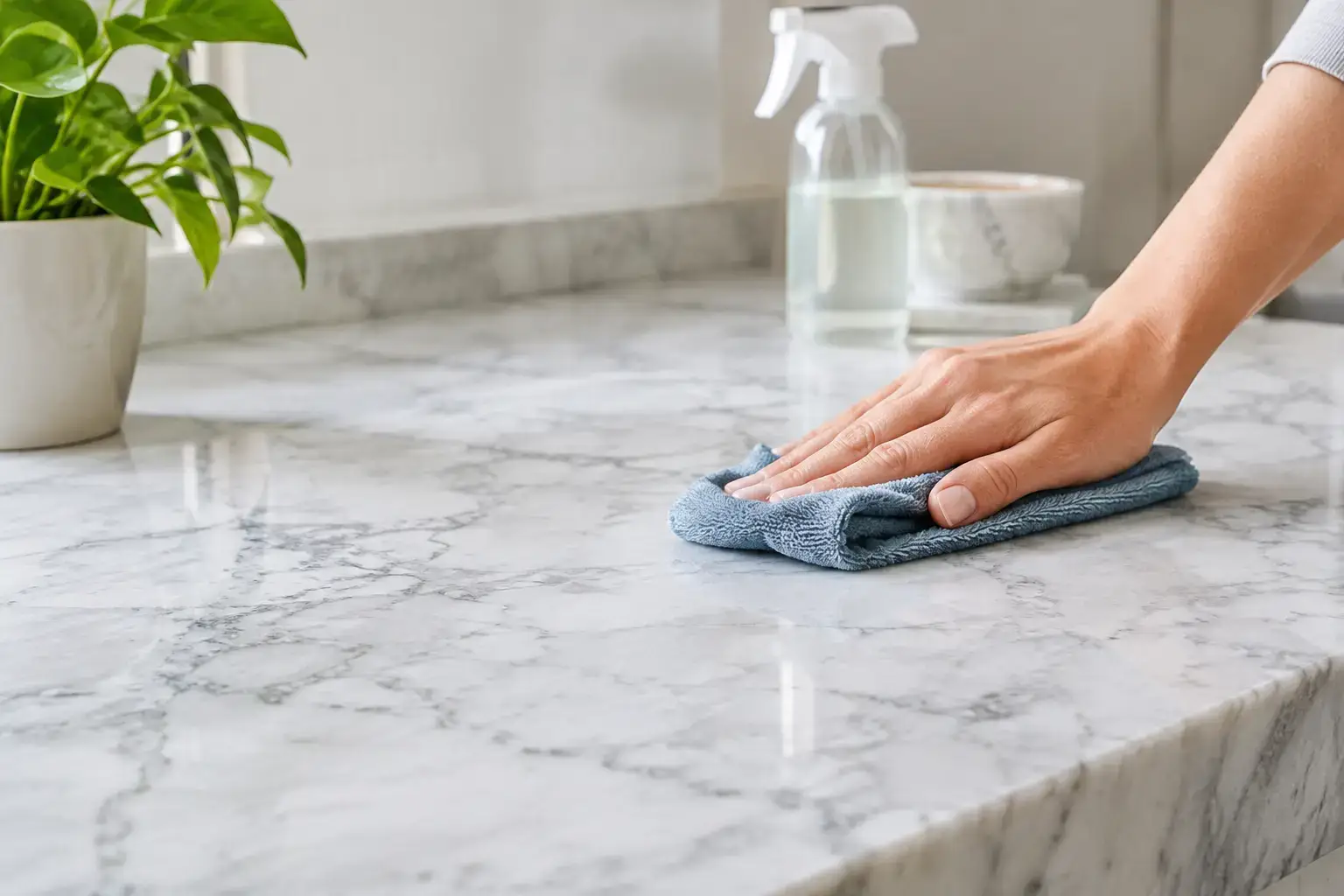
A perfect marble benchtop can lose its even, reflective finish from one unnoticed splash of lemon juice or a ring left beneath a glass. If you have asked, why does marble etch easily, the answer lies in the stone’s chemistry rather than a lack of quality. Marble is a luxurious natural material, but its calcium-rich surface reacts quickly with everyday acidic substances.
The good news is that etched marble does not usually need replacing. With the right assessment, honing, polishing and protection, a skilled stone restoration specialist can remove the damage and return the surface to a refined, consistent finish.
Why Does Marble Etch Easily?
Marble is formed when limestone is transformed by heat and pressure deep within the earth. Its primary mineral is calcite, a calcium carbonate compound. Calcite is naturally sensitive to acids, including mild household acids that may seem harmless.
When an acidic liquid touches marble, it creates a chemical reaction at the surface. Rather than simply sitting on top of the stone, the acid dissolves a minute amount of the calcite. This leaves the surface microscopically rougher than the surrounding polished stone. On a polished benchtop, vanity or floor, that disruption catches the light differently and becomes visible as a dull spot, pale mark or ring.
This is etching. It is not the same as a stain. An etch changes the stone’s surface texture and sheen, while a stain is discolouration caused by a substance entering the pores of the stone. Marble can suffer from both, and the correct treatment depends on identifying which issue is present.
The Everyday Causes of Marble Etching
Marble does not need prolonged exposure to strong chemicals to etch. Common kitchen, bathroom and entertaining habits can be enough to mark a polished finish. Citrus juice, vinegar, wine, tomato-based sauces, soft drinks and salad dressings are frequent causes on marble benchtops and dining tables.
Bathrooms present a different set of risks. Toothpaste, some personal care products, perfume, bathroom cleaners and descaling products can all affect marble vanities, wall tiles and floors. Even plain water can leave a visible ring if it contains acidic residue from a drink, cleaning product or personal care item.
The severity of the mark depends on several factors: the type of marble, the finish, the strength of the acid, how long it remains on the surface and the condition of the existing polish. Dense, highly polished marble may show etching more clearly because its gloss makes any loss of reflection immediately noticeable. Honed marble is still vulnerable to acid, but its lower-sheen finish can disguise minor etching more effectively.
Why Polished Marble Shows Damage So Clearly
A polished marble surface is prized for its depth, brilliance and mirror-like reflection. That high shine is also why etching can be so frustrating. A small etched area interrupts the smooth polish, so light scatters rather than reflecting evenly. What looks like a white stain is often simply a patch where the gloss has been chemically dulled.
Dark marbles can be especially unforgiving. On black, green, brown or richly veined stone, even a faint etch can appear as a cloudy, lighter patch. White marble may conceal some pale etching, but it can still develop dull rings, shadowing and uneven shine that detract from the overall elegance of the room.
Not every dull area is an acid etch. Abrasive cleaning pads, gritty dust, incorrect cleaning products and everyday wear can also reduce polish over time. Professional assessment matters because treating a worn surface as though it were a stain, or attempting to polish a local etch without blending the surrounding area, can produce an uneven result.
Sealer Helps With Stains, Not Acid Etching
One of the most common misconceptions about marble care is that sealing makes the stone acid-proof. A quality penetrating sealer is valuable because it helps slow the absorption of oils, coloured liquids and other contaminants. This gives you more time to wipe up spills before they become stains.
However, a standard impregnating sealer does not form a complete barrier against the chemical reaction that causes etching. Acid can still react with exposed calcite at the surface. For this reason, sealing should be part of a broader care plan, not the only line of defence for a busy marble kitchen or commercial hospitality area.
Where etching is an ongoing concern, specialist protective options may be worth considering. Anti-etch film can provide a practical protective layer for selected benchtops while preserving the appearance of the surface. It is particularly useful in high-use kitchens where the beauty of natural marble is desired but the demands of daily cooking are unavoidable.
How to Prevent Marble Etching at Home or Work
Marble is entirely suitable for kitchens, bathrooms, foyers and hospitality spaces, provided its characteristics are understood. The aim is not to treat marble as fragile, but to establish habits that protect its finish.
Wipe acidic spills promptly using a soft cloth and clean water, then dry the area rather than leaving moisture to evaporate. Use coasters under drinks, particularly wine, juice and soft drinks, and place trays beneath bottles, food preparation items and bathroom products. On kitchen benchtops, chopping boards and serving boards provide a sensible buffer between marble and acidic ingredients.
For routine cleaning, use a pH-neutral cleaner formulated for natural stone. Avoid vinegar, lemon-based products, bleach, abrasive powders, cream cleansers and generic bathroom or kitchen sprays unless they are specifically approved for marble. A product that works well on ceramic tile can permanently dull a marble surface.
In commercial settings, training cleaning staff is just as important as selecting the right products. A daily cleaning routine using unsuitable chemicals can gradually strip the polish from an entire marble floor, reception counter or bathroom vanity. Preventative care protects the visual standard of the property and reduces the frequency of restorative work.
Can Etched Marble Be Repaired?
In most cases, yes. The appropriate repair method depends on the depth and spread of the etching, the marble type and the desired finish. A faint isolated mark may respond to careful professional polishing, but more widespread etching often requires honing before the stone is polished back to an even sheen.
Honing uses specialised abrasive techniques to remove a controlled microscopic layer of damaged stone. This levels the etched area with the surrounding surface. The marble can then be polished to restore clarity and reflection, or finished with a satin or honed appearance where that better suits the stone and the client’s lifestyle.
Trying to repair etching with supermarket polish, abrasive paste or a DIY acid-removal product can create further problems. Marble restoration is not simply about making a spot shiny. The repaired section must blend with the rest of the slab, tile or floor so the finish looks natural from every angle. This requires an understanding of mineral composition, machinery, abrasives and the particular behaviour of each stone.
Deep etching may be accompanied by scratches, lippage between tiles, chips, stains or areas of worn polish. Addressing these issues together often delivers a more convincing result than repeatedly treating individual marks. Restoration can revive an entire surface for a fraction of the cost, mess and disruption associated with replacement.
Choosing the Right Finish for Your Marble
A high-polish finish delivers exceptional elegance, particularly in formal bathrooms, entry foyers and premium kitchens. It also requires a more attentive approach to spills and cleaning, because etches are easier to see. For households with young children, frequent entertaining or keen home cooks, a honed finish may offer a more forgiving alternative.
Honed marble has a smooth but low-sheen appearance. It retains the depth and natural character of marble without the mirror-like reflection of a polish. It can still etch, but minor marks are generally less conspicuous. This is a design and maintenance trade-off rather than a lesser finish.
At Grand Stone Restoration, treatments are tailored to the stone, its location and the way the space is used. A marble vanity in a guest ensuite needs a different protection strategy from a heavily used café counter or a family kitchen benchtop.
Marble earns its place in high-value interiors because no manufactured surface fully replicates its natural movement, depth and timeless character. Respecting its chemistry allows you to enjoy that beauty with confidence. When dull marks begin to interrupt the finish, timely professional restoration can preserve the stone’s elegance and extend the life of the surface for years to come.